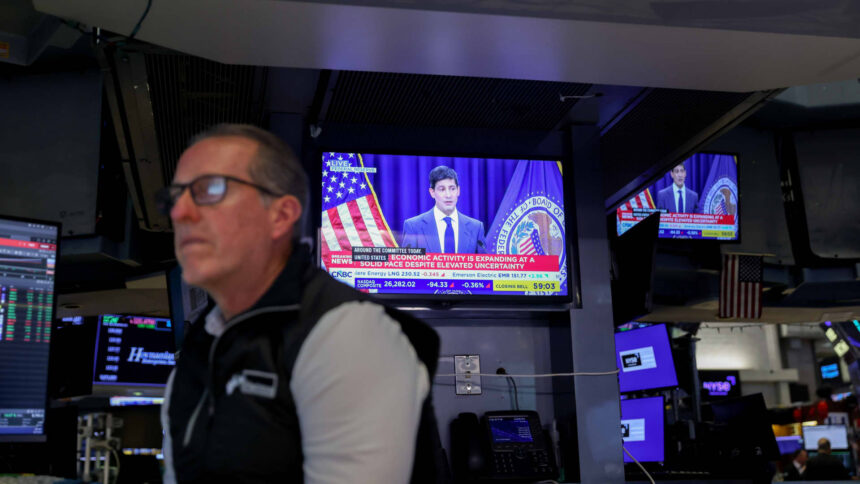
The Federal Reserve impacted Wall Street’s dynamics this week, yet the S&P 500 managed to maintain its upward trajectory, securing back-to-back weekly victories. This resilience was bolstered by optimistic developments related to ongoing conflicts, specifically the U.S. and Iran, which signed a memorandum of understanding aimed at extending their ceasefire and ensuring safe passage through the Strait of Hormuz. These developments led to a significant drop in oil prices for the week, further supporting stock market performance.
On Thursday, the S&P 500 rose 1.1%, with investors largely dismissing prior concerns regarding monetary policy that contributed to a 1.2% decline earlier in the week. Meanwhile, the Nasdaq surged by 1.9%, effectively compensating for its previous session’s downturn of 1.3%.
The mid-week dip was primarily triggered by the Fed’s assessments regarding the potential for an interest rate hike to address persistent inflation. Following the conclusion of its two-day June meeting, the central bank opted to keep rates unchanged, but comments from new Chairman Kevin Warsh during the Wednesday news conference indicated a steadfast commitment to the inflation target of 2%. The conversation surrounding this policy shift intensified market apprehensions, leading to one of the S&P 500’s worst performances on a “Fed day” under new leadership since 1994. Nonetheless, the market rebounded swiftly, culminating the short trading week with the S&P 500 reporting a 0.9% increase—marking its 11th winning week out of the last 12—and the Nasdaq achieving a 2.4% rise. The trading floor observed a closure on Friday due to the Juneteenth holiday.
In the chip sector, stocks exhibited notable growth throughout the week. Intel, a key player, reported a remarkable 10.6% increase on Thursday, reaching new heights following President Donald Trump’s revelation that Apple would collaborate with Intel to engineer and design chips domestically. This development added to Intel’s weekly gain of 7.6%. Other chip manufacturers, including Nvidia and Broadcom, also saw substantial boosts in their stock values, rising 2.9% and 4.7%, respectively, on Thursday. Arm Technologies recorded a nearly 5% uptick, achieving an all-time high, while Nvidia, Broadcom, and Arm posted weekly gains of 2.7%, 7.7%, and 15.4%, respectively. The iShares Semiconductor ETF (SOXX) saw an increase of almost 7.3% during this timeframe. Jim Cramer highlighted his enthusiasm for Intel, emphasizing the company’s pivotal role in data centers and its foundry business, which led to additional investment in the stock.
In contrast, broader technology stocks did not fare as well in the wake of the Fed’s commentary. Key holdings such as Microsoft, Amazon, Meta Platforms, and Alphabet experienced significant dips on Wednesday as investors sought refuge in perceived “safe haven” groups. Although Meta and Amazon managed to conclude the week positively—advancing 1.8% and 2.5%, respectively—others did not enjoy similar performance. Alphabet’s stocks rose by 2.3%, but Microsoft lagged behind, declining by 2.9% over the week.
Amid these developments, optimism regarding a potential resolution in the U.S.-Iran conflict surged earlier in the week, following Trump’s announcement of the ceasefire agreement. Unfortunately, planned follow-up talks that were supposed to take place on Friday did not materialize. This agreement grants both nations a 60-day window to negotiate a final peace deal, further impacting market sentiments. Cramer underscored confidence in his investment in Capital One, a consumer bank poised to benefit from declining oil prices, as U.S. crude fell nearly 10% this week, contributing to a decrease in the national average for unleaded gasoline below $4.
Investors took note of these market fluctuations, keeping a close eye on the implications of both geopolitical events and Federal Reserve policies as they navigate their investment strategies in the current economic climate.