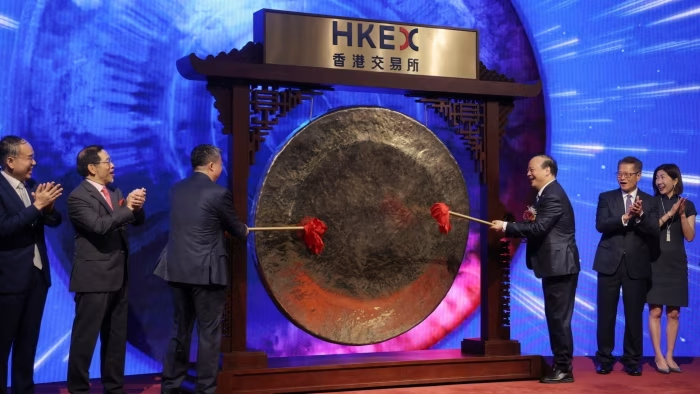
In a notable shift in Hong Kong’s capital markets, Western banks have emerged as leading players in equity sales, capitalizing on deal-making opportunities amid ongoing US-China tensions. According to data from Bloomberg, major financial institutions such as Morgan Stanley and Goldman Sachs have facilitated billions in equity offerings this year, significantly contributing to a revival in Hong Kong’s financial landscape.
Morgan Stanley has topped the list, raising an impressive $11.6 billion in equity offerings up to the end of November. Goldman Sachs follows with $7.4 billion, while Chinese banks like Citic Securities and China International Capital Corporation (CICC), along with UBS from Switzerland, round out the top players. This data encompasses both initial public offerings (IPOs) and follow-on share sales, which have attracted a wave of international investment, particularly from Chinese companies. Noteworthy transactions include a remarkable $4.6 billion share sale by Contemporary Amperex Technology Co. Ltd. (CATL), the world’s largest battery maker, and the IPO of Zijin Gold.
The resurgence of Hong Kong’s capital markets reflects a broader trend in which Chinese companies are keen to raise substantial amounts of capital in the city. Saurabh Dinakar, head of Asia Pacific global capital markets at Morgan Stanley, noted that there has been a robust rebound in equity issuance from Chinese firms, with the overall ECM (equity capital markets) activity reaching $73.1 billion so far this year, which marks a 232 percent increase compared to the same timeframe in 2024.
Despite the growth, the scrutiny faced by banks operating in Hong Kong is intensifying. Recently, a US congressional committee reached out to Morgan Stanley’s CEO, Ted Pick, seeking more information regarding the bank’s underwriting role for Zijin Gold, linked to allegations of human rights abuses in Xinjiang. Although Morgan Stanley did not comment on the inquiry, this incident highlights the complex interdependencies and the delicate navigation required by financial institutions operating in this politically sensitive environment.
Moreover, while Western banks continue to play a critical role in fostering international investment into major deals, there is a notable uptick in activity from Chinese banks aiming to increase their foothold in Hong Kong. These local banks are eager to capture a larger share of advisory fees in a territory where deals often command higher costs compared to those in mainland China. CICC has even announced plans to acquire two smaller brokerages, signaling a trend of aggressive expansion among Chinese financial firms in the region.
Rowena Chang, from the rating agency Fitch, commented on the partnerships forming between U.S. investment banks and local Chinese counterparts, indicating that many large transactions now typically involve both a U.S. investment bank and a local partner. This collaboration is especially beneficial for Chinese firms looking to navigate the complicated regulatory landscape, as these local banks maintain strong connections with regulatory bodies such as the China Securities Regulatory Commission (CSRC).
As Chinese securities firms ramp up their activities in Hong Kong, they are expected to facilitate even more IPOs and capital raising initiatives, thereby solidifying the territory’s status as a vital conduit for cross-border financing. The blend of Western and Chinese banking expertise appears to be fostering a thriving environment for equity sales, despite the overarching geopolitical uncertainties.