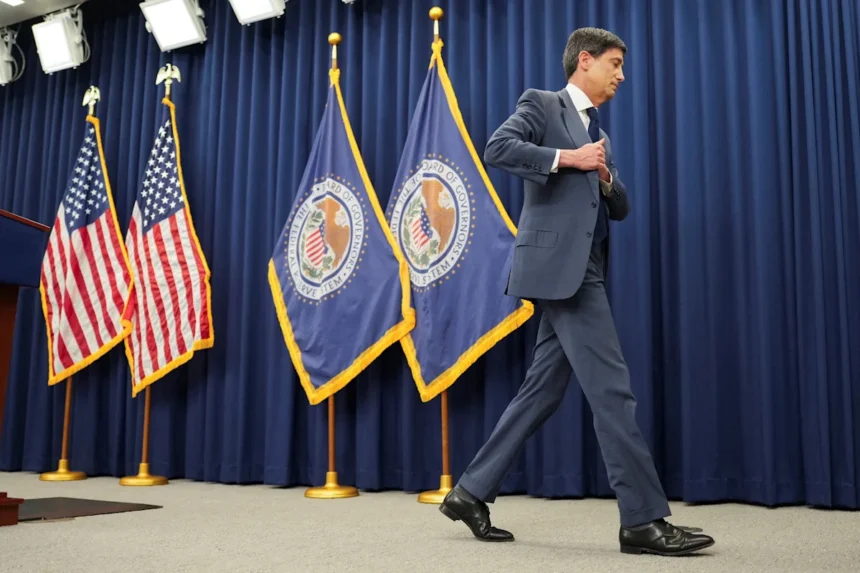
Kevin Warsh made an impression during his inaugural press conference as the new Federal Reserve chairman this week, demonstrating a blend of charisma and a willingness to challenge existing norms. His lighthearted approach to introducing five new task forces aimed at driving change within the central bank showcased a contrast to the serious demeanor often observed in his predecessors. While engaging in banter with reporters, Warsh effectively deflected efforts to extract specific forward guidance from him, indicating a strategic shift in communication style.
His demeanor suggested a departure from the weighty presence many have associated with former Fed leaders, encapsulating a political polish that made him appear more accessible. Warsh exhibited a nimbleness in his responses, signaling a potential overhaul of recent Federal Reserve protocols. Among the changes he hinted at was a reevaluation of the much-debated Summary of Economic Projections (SEP), commonly referred to as the dot plot.
Analyses, such as one from Yahoo Finance, have revealed a dismal track record in the Fed’s predictive accuracy regarding interest rate forecasts. The findings show that projections are often based on existing conditions rather than a thorough analysis of future economic landscapes. This lack of clarity often leads to significant misses during pivotal moments influenced by external shocks—like the COVID pandemic—or miscalculations regarding economic conditions and the efficacy of interest rates.
Notably, Warsh opted out of submitting his own forecasts for the SEP, casting doubt on its future utility, and he seems inclined toward a return to the more restrained communication style reminiscent of Alan Greenspan’s tenure—characterized by fewer public disclosures.
The task forces that Warsh introduced will tackle crucial areas including communication strategies, the Fed’s balance sheet, data utilization, productivity and employment trends, and the inflation framework. Each of these focal points is essential for institutional evolution, especially for an entity as influential as the Federal Reserve.
With a mix of confidence and humor, Warsh commented on inflation, stating, “I’ve said for years that inflation is a choice.” His commitment to curbing inflation reflects a dedication to maintaining the Fed’s target rate of 2%. As the FOMC approaches its next meeting in late July, questions loom regarding whether Warsh will advocate for a rate increase or hold off until the task force reports are complete.
The markets and economic observers are poised to watch how Warsh’s approach unfolds, monitoring his ability to balance ambition with realistic expectations. The potential for either constructive reform or overreach will be closely scrutinized in the months ahead.