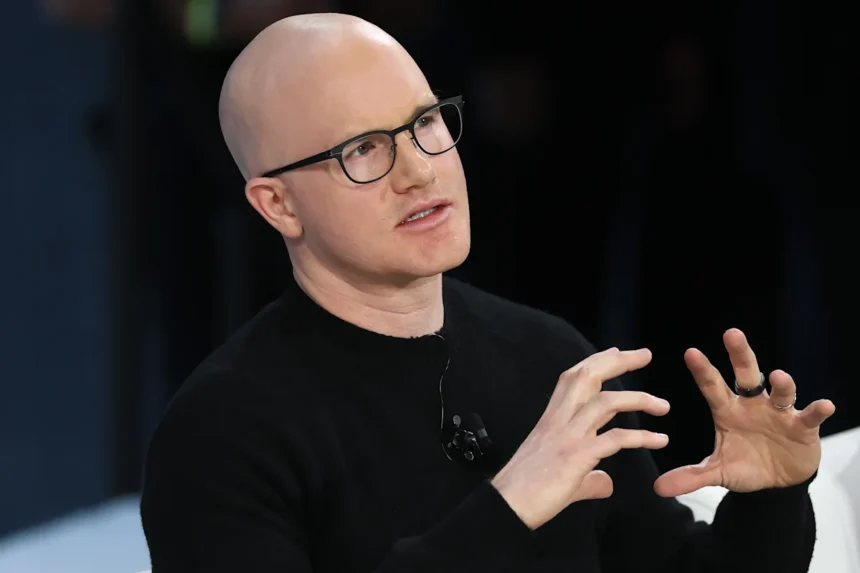
Coinbase has embarked on an expansive transformation aimed at redefining its role in the financial services landscape, moving beyond its traditional crypto trading roots. Co-founder and CEO Brian Armstrong articulated this vision during a recent appearance on Yahoo Finance’s Power Players podcast. He emphasized the company’s commitment to being recognized as a provider of superior financial services underpinned by cryptocurrency technology.
At a Systems Update event in New York City, Coinbase unveiled its most ambitious product rollout to date. This ambitious shift marks the company’s evolution from a crypto exchange to a comprehensive platform that integrates cryptocurrency, traditional stocks, exchange-traded funds (ETFs), prediction markets, perpetual futures, tokenized assets, and payment services—all accessible from a single user account.
One of the standout features announced was Coinbase Advisor, which positions itself as one of the first SEC-registered AI investment advisers globally. This tool is designed to issue precise buy and sell recommendations while analyzing user portfolio histories and executing trades around the clock. Furthermore, Coinbase revealed plans for tokenized equities, which will be fully backed by the respective underlying stocks on a one-to-one basis.
The Wall Street community reacted positively to this series of product announcements, with analysts noting the increasing utility and competitiveness of Coinbase in the evolving digital assets space. BTIG analyst Andrew Harte expressed optimism, stating that the platform is enhancing its offerings by incorporating traditional finance (TradFi) investment tools. Current analyst ratings reflect this positive sentiment, with approximately two-thirds designated as Buy or Overweight.
These advancements come at a critical juncture for Coinbase, as the company has faced rising pressure on its stock due to recent quarterly performance. Sales in the first quarter fell short of analyst expectations, resulting in a 31% year-over-year decline. Furthermore, both crypto trading volumes and spot trading volumes have seen notable decreases.
In addition to internal challenges, Coinbase finds itself amid a renewed public feud with JPMorgan CEO Jamie Dimon. Their conflict reignited earlier this year at the World Economic Forum in Davos, where Dimon publicly criticized Armstrong’s multimillion-dollar lobbying for the proposed Digital Asset Market Clarity Act. This legislation aims to establish regulatory clarity for cryptocurrencies and would allow platforms like Coinbase to offer yield-like incentives on stablecoin holdings. Dimon has been adamant that such a move could undermine traditional banking standards.
Armstrong remains open to dialogue with Dimon but insists that productive compromise between the two sectors is crucial as the legislation advances toward a full Senate vote. During the interview, Armstrong shared insights on the current state of bitcoin, suggesting that it might have reached a bottom around $60,000, influenced by market trends, upcoming legislation, and the potential capital flows back into the market.
He noted the emergence of an “agentic economy,” one increasingly reliant on AI and automation, creating a demand for new financial infrastructure. Armstrong believes Coinbase is uniquely positioned to lead this transformation because of its extensive holdings of cryptocurrency.
In recent discussions, the future of Coinbase and its expansion into comprehensive financial services hint at a broader trend of integrating traditional finance with cryptocurrency, reflecting the company’s vision of building better financial services for a rapidly changing economic landscape.