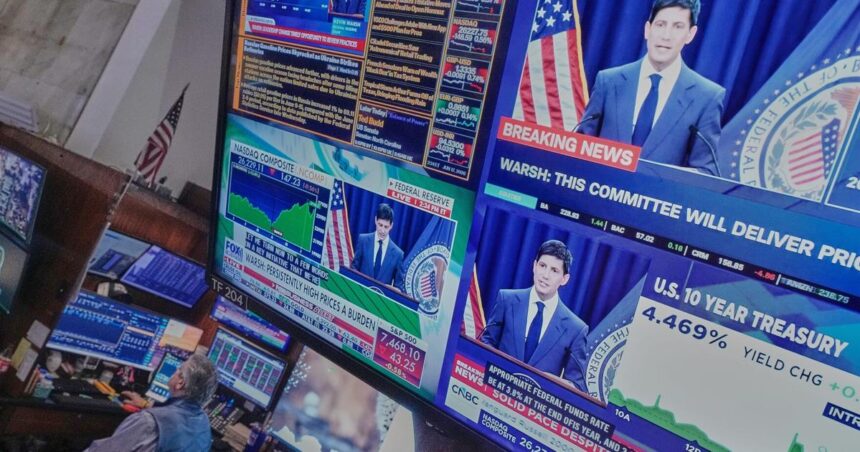
The Federal Reserve is undergoing a significant shift in communication strategy under the new leadership of chair Kevin Warsh. Traditionally known for increasing transparency over the past few decades, the Fed is now pivoting towards a more opaque approach in a bid to recalibrate financial market expectations and reduce their dependency on Fed guidance.
In his initial press conference, Warsh unveiled substantial changes, notably slashing the Fed’s interest-rate decision statement from 341 words to a mere 132. This concise statement signified a departure from previous practices, as it deliberately omitted any “forward guidance,” leaving financial markets to speculate about future moves. Analysts are warning that this shift could lead to increased volatility in stock and bond prices, potentially resulting in higher borrowing costs for consumers and businesses. George Pearkes, a global macro strategist at Bespoke Investment Group, stated that such forward guidance has historically helped to stabilize market expectations and lower borrowing rates.
Market reactions were immediate and pronounced. After the announcement, the yield on the 10-year Treasury, pivotal for setting mortgage rates, rose to 4.49% from 4.43%, before making a slight adjustment in subsequent trading. Likewise, the two-year Treasury yield jumped sharply, reflecting heightened expectations for the Fed’s actions. The S&P 500 index fell by 1.2%, illustrating the turmoil in financial markets following Warsh’s communication changes.
Drawing comparisons to the era of former chair Alan Greenspan, Warsh seems to advocate a communication strategy reminiscent of the 1990s, characterized by more ambiguous messaging. Greenspan’s era was marked by a lack of clear guidance, often leaving investors guessing, which sometimes led to sharp market reactions, such as the sudden drop of the Dow Jones Industrial Average by 2.4% following an unexpected rate announcement in 1994.
Warsh’s approach is part of a broader reform initiative encompassing five task forces that will scrutinize various aspects of the Fed’s operations, including its communications and economic analysis methods. His intention to reconsider the regularity of press conferences and the nature of economic projections signals a potential retreat from the heightened transparency established post-2008 financial crisis. Matthew Luzzetti, chief U.S. economist at Deutsche Bank, remarked that this marks a significant shift away from the trajectory of increased openness favored by his predecessors.
Historically, Fed chairs have found that providing guidance helps to manage markets’ expectations effectively. By signaling future moves, they can influence longer-term rates, which in turn impact consumer borrowing costs. However, Warsh believes that overreliance on such guidance can create skewed perceptions of the economy. He expressed a desire for financial markets to base their predictions on economic data rather than the Fed’s communications.
Economics professor David Andolfatto acknowledged the potential pitfalls of forward guidance, particularly in response to unforeseen global events that can disturb economic forecasts. Still, he emphasized the need for clear contingency plans to navigate such events, suggesting that simply abandoning guidance without a substitute plan could lead to confusion.
The real test of Warsh’s bold strategy will emerge during economic turbulence, where proactive communication could play a crucial role in stabilizing the markets. The effectiveness and sustainability of his approach will be closely scrutinized as the Fed navigates future economic challenges.