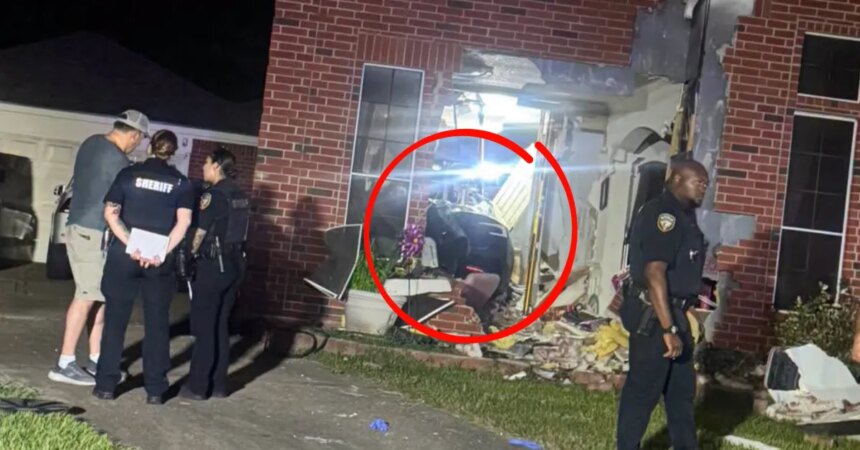
A tragic incident unfolded in Katy, Texas, when a Tesla vehicle, allegedly operating under Autopilot, veered off a residential road and crashed into a home, resulting in the death of a 76-year-old woman inside. The accident occurred around 8 p.m. in the 21300 block of Rose Hollow Lane, prompting an immediate response from the Harris County Precinct 5 Constable’s Office and the Harris County Sheriff’s Office.
Initial investigations have revealed that the Tesla failed to make a right turn at an intersection, continuing forward at a high speed before striking the residence directly. The elderly woman, who was in the front room when the vehicle crashed through the wall, was airlifted to Memorial Hermann hospital via Life Flight but was later pronounced dead.
The driver, a 44-year-old man, was transport to the hospital by ambulance, reportedly showing no signs of intoxication and fully cooperating with the investigation. As of now, no charges have been filed, and inquiries into the incident are ongoing.
The driver disclosed to authorities that he had the Tesla on Autopilot at the time of the crash; however, this claim has not been independently verified. Sergeant Alex Turman from the Harris County Sheriff’s Office underscored the need for further investigation into the circumstances surrounding the accident, particularly concerning Tesla’s automated driving features.
Law enforcement is collaborating with specialists familiar with Tesla vehicles and the driver to ascertain the vehicle’s operation leading up to the crash. Notably, there is ambiguity about whether the Autopilot system referred to is the standard driver-assist feature or Tesla’s more advanced “Full Self-Driving” software. It’s crucial to highlight that both systems require driver vigilance and do not render the vehicle fully autonomous.
This incident arises amid increasing scrutiny of Tesla’s driver-assistance technologies. The National Highway Traffic Safety Administration (NHTSA) has been investigating roughly 2.9 million Tesla vehicles over their “Full Self-Driving” capabilities, which reportedly have led to incidents of running red lights and other dangerous maneuvers. The agency’s probe has escalated to a thorough engineering analysis, a significant step prior to a potential recall.
The situation raises broader concerns regarding user complacency with semi-autonomous driving systems, spotlighting the need for more rigorous driver engagement and monitoring measures. Critics argue that Tesla’s marketing and nomenclature around its driving technologies, such as “Autopilot” and “Full Self-Driving,” might mislead drivers into believing they can disengage fully from vehicle operation.
As this investigation unfolds, it underscores the human cost of technological overreach. The tragic loss of life in this incident highlights the very real dangers that can arise when advanced automotive technology is not fully understood or respected by its users. The implications of this incident may resonate beyond this unfortunate event, prompting renewed discussions about safety standards and user education in the ever-evolving landscape of autonomous vehicle technology.