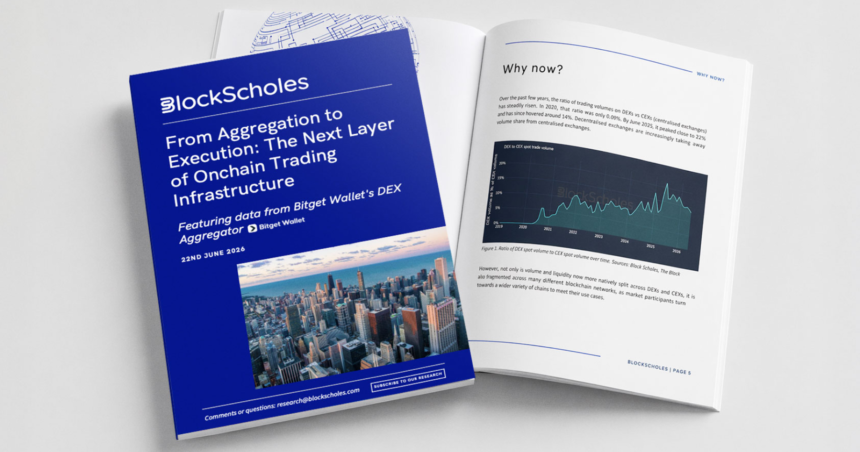
Bitget Wallet, a self-custodial crypto wallet, has gained recognition in a recent quantitative benchmark report released by Block Scholes. The report evaluates how execution quality varies as on-chain trade sizes increase. Notably, decentralized exchanges have surged, now representing approximately 14% of the global crypto spot volume, a stark rise from less than 0.1% just five years ago. The research highlights that in the context of an expanding $300 billion stablecoin market, mere access to liquidity is no longer the distinguishing factor; rather, the efficiency of a routing engine in navigating this liquidity has emerged as a critical determinant.
The report identifies a pressing issue: fragmentation within the crypto liquidity landscape. This liquidity is now dispersed across numerous blockchain networks and trading venues. Effectively, the routing engine becomes crucial in deciding the cost-effectiveness of trades. The study utilized thousands of live API quote comparisons across four platforms—Bitget Wallet, KyberSwap, 0x, and Jupiter—analyzing trade sizes ranging from under $1,000 to $100,000 across Bitcoin, Ethereum, Solana, and stablecoin pairs.
A case study featured in the report involved a $10 million stablecoin swap, illustrating the tangible effects of an intelligent routing engine. By strategically splitting the order across various liquidity pools rather than relying on a single venue, the engine managed to save approximately $8,000 in execution value. This financial impact becomes even more pronounced at institutional volumes, where differences in routing infrastructure could significantly influence overall costs.
The report also highlights the changing landscape of USD-pegged stablecoin supply, which has skyrocketed from below $1 billion in 2018 to over $300 billion today, with projections by U.S. Treasury Secretary Scott Bessent indicating it could reach $2 trillion by 2028. Data from Bitget Wallet suggests that average swap sizes on its platform have expanded nearly fivefold in the first five months of 2026, peaking at over $1,200. This trend signals a shift toward larger and more sophisticated participants engaging in on-chain trading.
Notable performance differences were observed among the four platforms, particularly at larger trade sizes involving major pairs like Bitcoin and Ethereum against the dollar. Bitget Wallet’s routing engine stands out for its ability to integrate gas costs into its routing decisions upfront, dynamically distributing large orders across available liquidity pools according to real-time depth. These design choices have been identified as key factors contributing to Bitget Wallet’s performance advantage at institutional trade sizes, where its quoted prices outperformed competitors in up to 78% of comparisons.
Alvin Kan, COO of Bitget Wallet, emphasized the increasing relevance of routing engine quality as average trade sizes rise and liquidity becomes more fragmented. He noted that while many platforms have addressed access to liquidity, the real question now is whether their systems are making optimal decisions with that liquidity. This research underscores the measurable differences that can arise from routing engine performance.
Thahbib Rahman, a research analyst at Block Scholes, affirmed that decentralized exchanges have been progressively gaining market share from centralized venues, with liquidity and volume becoming more distributed across various blockchain networks. He anticipates continued fragmentation as more applications are developed on-chain, further amplifying the need for competitive aggregators capable of delivering institutional-grade execution quality.
The full report, titled “From Aggregation to Execution: The Next Layer of Onchain Trading Infrastructure,” is accessible on the Block Scholes website.
Bitget Wallet, established in 2018, has catered to over 90 million users globally, providing a self-custodial account for crypto-related activities. It supports more than 1 million tokens across over 130 blockchains, along with 100+ fiat currencies and offers Visa and Mastercard crypto cards. The wallet prioritizes security through industry-standard key encryption, a real-time risk engine, and independent audits, backed by a protection fund exceeding $300 million. In 2022, Bitget Wallet raised $100 million in a funding round led by Dragonfly.
Block Scholes specializes in delivering institutional-grade research, data, and analytics focused on crypto derivatives, with its oracle service providing essential market data to DeFi protocols, margin engines, and trading applications.