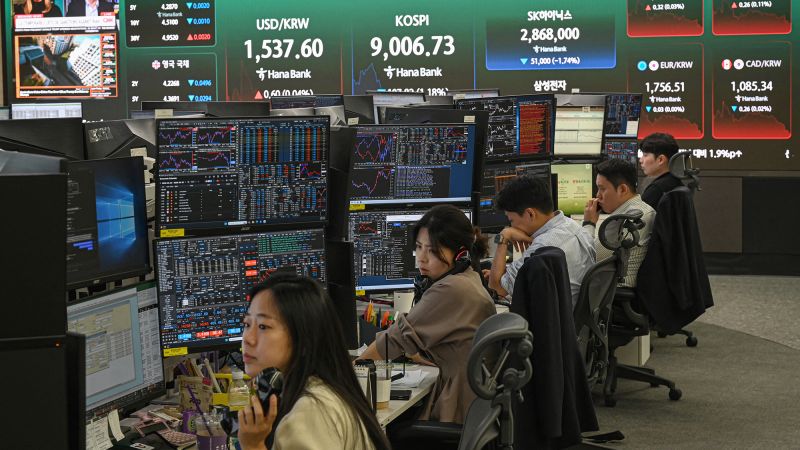
South Korea’s stock market experienced a dramatic 10% plunge on Tuesday, primarily driven by significant declines in global tech stocks. The sell-off in South Korea followed a mild dip in U.S. tech shares on Monday, which quickly escalated into full-blown panic trading in Seoul. The Kospi index’s sharp fall triggered a circuit breaker, necessitating a 20-minute halt to trading as investors scrambled to assess the situation.
Leading this decline were major memory chipmakers SK Hynix and Samsung, which plunged over 12%. These two companies, crucial to the South Korean economy and comprising nearly half of the Kospi’s total market value, significantly influenced the overall downturn. Investors seemed to react more to market sentiment than any specific negative news, as no clear catalyst emerged for such fervent selling.
While some analysts pointed to disappointing performances from U.S. giants like Google and SpaceX as potential triggers—Google’s 5% drop linked to a high-profile AI executive’s departure and SpaceX’s typical post-IPO jitters—others speculated that traders were also factoring in the possibility of the Federal Reserve raising interest rates later this year. This speculation was not new; recent remarks from new Fed Chairman Kevin Warsh underscored the Fed’s commitment to controlling inflation, which had previously spooked the market.
The rapid increase in valuations for AI-related companies has imbued the market with a sense of volatility, leading many to speculate that even small shifts could prompt significant sell-offs. The Kospi index, having rallied an impressive 90% this year, now faces a precarious situation where traders and algorithms alike are skittish about potential downturns.
The investor anxiety did not remain isolated to South Korea. The ripple effect caused Japan’s Nikkei to drop 3.6%, with tech giant Softbank tumbling 15%. Other Asian markets also showed declines, with many indexes falling by more than 1%.
In the United States, tech stocks seemed poised for another challenging day. Nasdaq futures indicated a drop of 2.8%, following a 1.3% decrease the previous day. Despite the recent pressures, tech stocks have not fallen drastically, with the Nasdaq only down 3.4% from its record high set earlier in June.
Futures linked to the broader S&P 500 were down 1.2%, while the Dow projected an opening loss of approximately 200 points, or 0.3%. This recent volatility comes as stocks have largely hovered near record levels. Following President Trump’s announcement of a ceasefire in Iran in April, market focus shifted back to AI advancements and the Federal Reserve’s stance on interest rates.
Amidst the turmoil in equity markets, oil prices saw a slight decrease on Tuesday, as traders responded positively to signs of progress in peace negotiations. This cautious optimism contrasts sharply with the tumult gripping the stock markets, illustrating the complex interplay of geopolitical events, economic indicators, and investor psychology shaping current market dynamics.