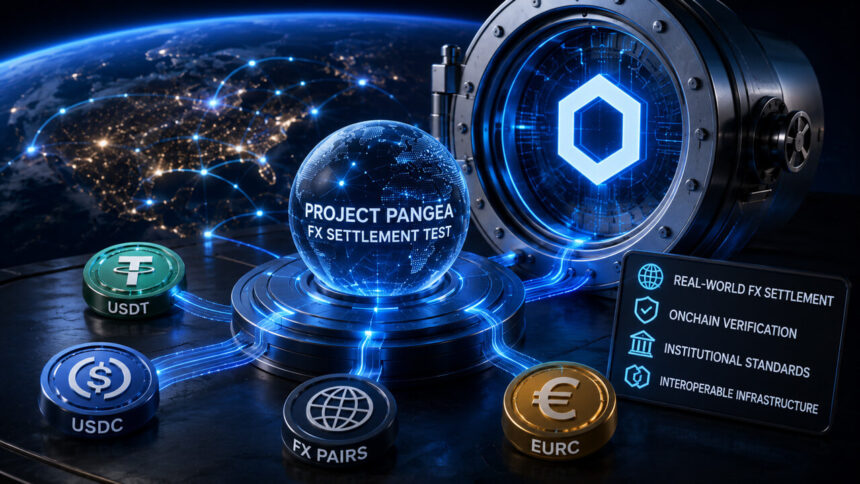
Chainlink has unveiled Project Pangea, a pioneering initiative aimed at revolutionizing the foreign exchange (FX) settlement process for banks by utilizing stablecoins to facilitate T+0, or same-day, settlements. The framework was officially announced on June 23 and is designed around fiat-referenced digital assets, specifically the euro (EUR) and Korean won (KRW) stablecoins. By integrating these stablecoins into the FX settlement process, Chainlink aims to minimize the time lag traditionally observed between trade execution and the final exchange of funds.
The essence of T+0 settlement is that both the exchange of ownership and payment occur on the same day the trade is executed, contrasting sharply with the conventional model which often delays settlement by one or more business days. This advancement could significantly mitigate settlement risk; specifically, it may eliminate the risk of one party completing their payment while the other waits, thus freeing up capital and reducing counterparty exposure.
Project Pangea targets a critical challenge within FX markets: the often prolonged gap between trade execution and fund exchange. The initiative seeks to transition from slower settlement cycles to T+0 atomic settlement, a model where both currency legs of a transaction are exchanged simultaneously. Essentially, the project investigates whether compliant stablecoins can effectively serve as settlement instruments for banks—while allowing them to retain their existing communication infrastructure.
Chainlink’s approach hinges on compatibility with established banking infrastructures, specifically the SWIFT messaging system and ISO 20022 standards. These frameworks are crucial for international banks, as they standardize the exchange of payment instructions across borders. The stability and usability of the EUR/KRW pairing are central to the project, supported by institutions like Qivalis, FairSquareLab, and UniKA, which represent the euro and Korean markets respectively.
The announcement distinguishes what is being tested through Project Pangea from the broader requirements banks will need to meet for adoption. The project is currently exploring:
– A framework for T+0 FX settlements using compliant stablecoins for both EUR and KRW.
– A robust payment-versus-payment design that facilitates simultaneous currency trade exchanges.
– The establishment of bank-grade liquidity, dispute handling, and redemption processes.
– Integration of existing workflows with the SWIFT and ISO 20022 systems for seamless bank operations.
– Necessary operational approvals from treasury, legal, risk, and compliance departments.
The project essentially aims to address deeper operational challenges rather than merely the speed of settlements. By utilizing stablecoins that can ensure reliable currency delivery, Project Pangea seeks to reduce the operational and counterparty risks traditionally associated with institutional FX settlement. In traditional FX operations, settlement delays expose firms to risks; Pangea’s atomic-settlement approach aims to significantly reduce such mismatches, provided that the framework can be successfully validated through controlled bank trials.
An important aspect of the announcement is its citation of a working group comprised of financial institutions in Europe and South Korea managing over $10 trillion in assets. This collective includes Qivalis, which operates a 37-bank euro stablecoin consortium, alongside UniKA’s coalition in the Korean banking system. This institutional backing lends credibility to the project, though successful rollout will ultimately hinge upon rigorous bank trials and adequate liquidity provisions.
The euro component of the project, backed by the robust institutional presence of Qivalis, is positioned to adopt a regulated euro-denominated stablecoin by the latter half of 2026, pending regulatory approvals. This further establishes a substantive framework for the Pangea initiative. In contrast, details regarding the operational mechanics for the won-denominated transactions still require substantial development to ensure a seamless integration into existing banking practices.
While Chainlink remains a prominent figure in the crypto space, its role in Project Pangea centers on enhancing financial infrastructure rather than merely facilitating consumer-grade transactions. The success of this initiative has broader implications for the way tokenized assets and money can be integrated into established institutional workflows.
The next stages for Project Pangea will involve operational testing and clarity on the specific stablecoins that will be used for real transactions. Key milestones will include the execution of a pilot program that identifies the mechanisms for liquidity, redemption, and compliance. As the project progresses, its potential to reshape FX settlements will depend on its ability to maintain compatibility with existing banking operations while achieving regulatory and operational validation. If successful, Project Pangea may set a precedent for the future integration of stablecoins into mainstream banking systems, ultimately transforming the landscape of international FX trading and settlement.