The U.S. stock market showed signs of recovery on Friday, buoyed by a decline in oil prices that returned to pre-war levels with Iran. The S&P 500 experienced a rebound, increasing by 0.5% following an early loss that saw it down 0.9%. Despite this upturn, the index remains on track for its second losing week out of the last 13, primarily due to declines in artificial intelligence-related stocks.
As of 11:45 a.m. Eastern Time, the Dow Jones Industrial Average rose 194 points, or 0.4%, while the Nasdaq composite gained 0.5%. A notable factor contributing to the positive market sentiment was a 4.5% drop in the price of Brent crude oil, settling at $72.13. This reduction came after a period of heightened prices following U.S. and Israeli military action against Iran, which previously resulted in increased concerns over oil supply disruptions.
The dip in oil prices benefited several companies that depend heavily on fuel costs, notably United Airlines, whose shares climbed by 2.1%. Health care stocks also displayed strength in the market, significantly influenced by a recommendation from a committee of the European Medicines Agency for the approval of several medications. Eli Lilly saw its stock surge by 6.8% while benefiting from the regulatory news.
Despite the overall market lifting, the performance of AI stocks weighed heavily on the indices. After experiencing a significant rally in recent years, these stocks faced renewed scrutiny regarding their profitability, raising concerns that their surging prices could not be sustained. Micron Technology, for example, saw a substantial decline of 3.3%, reflecting investor apprehension about pricing pressures from increased memory costs on major manufacturers like Apple.
The volatility in AI stocks has been highlighted by SpaceX, which initially fell to a low of $149, reflecting a 2.9% loss, only to recover and gain 2.2% later in the day. The company had recently made headlines with its initial public offering, which saw its stock soar from $135 to over $225 in just a few days, before settling into a choppy trading pattern.
The most significant decline in the S&P 500 came from Onsemi, whose shares plummeted by 21.6% after it announced plans to acquire Synaptics in a $7 billion all-stock deal.
In the bond market, Treasury yields dropped in tandem with oil prices, with the yield on the 10-year Treasury falling to 4.37%, down from 4.40% late Thursday. This movement was partially driven by a report indicating a decrease in inflation expectations among U.S. consumers, easing concerns of a potential inflationary spiral.
Global bond yields have been under pressure due to inflation concerns, impacting economies and leading to higher interest rates on loans, including mortgages. This dynamic has exerted pressure on AI stocks, which are often regarded as particularly expensive investments.
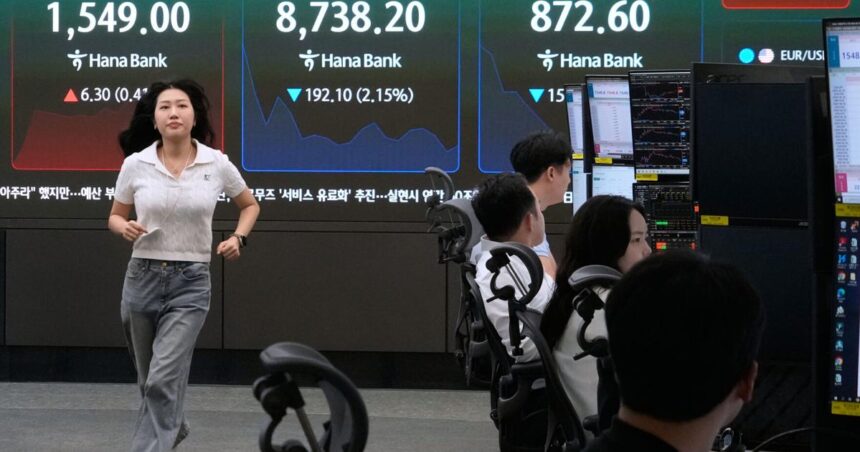
The situation in Asian markets reflected a broader apprehension, with significant losses attributed to AI stock trends. Japan’s Softbank Group Corp plummeted 12.5%, contributing to a 4.2% drop in the Nikkei 225, amid speculation that OpenAI might postpone its much-anticipated IPO. Similarly, in South Korea, SK Hynix fell by 8.4%, and Samsung Electronics experienced a steep 5.3% decline, further underscoring the cautious sentiment surrounding AI investments in the region.