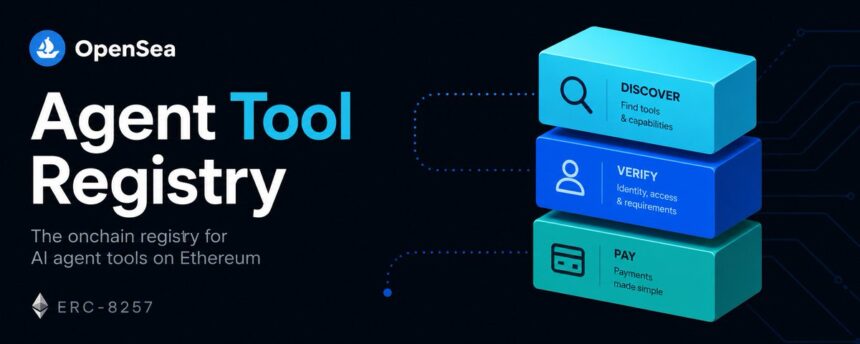
In a significant advancement for both NFT holders and developers, a new Ethereum standard called ERC-8257 has been integrated by OpenSea, paving the way for a decentralized AI Agent economy. This standard allows for a seamless interaction between AI Agents and on-chain tools, enabling them to autonomously fulfill requirements, including purchasing NFTs when necessary.
Currently, many tools for AI Agents are scattered across various platforms, lacking a centralized registry for easy access and management. Developers often face challenges in publishing their tools, managing access, and monetizing effectively. With ERC-8257, these inefficiencies are addressed by establishing a comprehensive open registry, akin to the App Store for software applications.
This on-chain registry allows developers to publish tools, specify pricing and access rules, and ultimately set the groundwork for a robust AI Agent ecosystem. With this infrastructure, developers can enforce their access rules directly and manage subscriptions, making it easier for NFT holders to leverage their assets.
For instance, if an AI Agent needs to access pricing data but faces a denied request due to lack of access rights associated with an NFT, it can autonomously purchase the required NFT on-chain. Once acquired, the Agent can access the tool instantly, showcasing the efficiency of the system. Imagine an AI Agent trying to evaluate NFT prices—if it encounters a pricing tool that requires special NFT ownership for discounted rates, it can quickly buy the necessary token and try again, achieving results in seconds instead of days.
The use of blockchain technology is pivotal here, as it supports the diverse access models needed for various applications. ERC-8257 supports a range of requirements, from NFT ownership and active subscriptions to more complex conditions like zero-knowledge proofs and DAO voting outcomes. It provides a modular design that ensures flexibility for developers while maintaining essential security measures.
Each NFT collection now holds potential new uses. By owning specific tokens, users can unlock discounted access to analytical tools, gain entry to paid services, or secure limited participation in various community-driven projects. This opens new avenues for engagement and monetization within the NFT space.
As for the technical details, ERC-8257 relies on a structured process for tool registration, which includes submitting a manifest detailing functionalities and access protocols. The protocol’s architecture allows for flexibility, enabling developers to integrate various payment mechanisms to suit their needs.
To highlight the real-world implications, consider an AI Agent using an NFT appraisal tool. Initially denied access due to a lack of necessary NFTs, the Agent autonomously purchases the required token, after which it successfully retrieves pricing data. This streamlined interaction occurs without any human oversight, illustrating the potential for AI-driven efficiency in the digital asset space.
Forthcoming developments may include professional-grade pricing oracles, advanced analytics, and other subscription services enabled by this new framework. As this ecosystem progresses, it is vital for developers to engage in the ongoing refinement of ERC-8257 to enhance its capabilities and usability.
OpenSea’s Tool SDK facilitates the building of these tools, attracting developers to participate in this emerging landscape. With the draft of ERC-8257 now available for collaboration, there are opportunities for new projects and innovations to flourish within the AI Agent economy.
Engagement from the community is encouraged as the standard is finalized, highlighting the cooperative effort necessary to realize this ambitious vision. Interested parties are invited to join discussions to shape the future of this promising new infrastructure within the blockchain ecosystem.