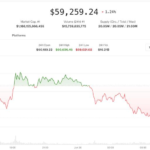
Bitcoin (BTC) is currently hovering around $59,500 following a significant correction over the past two weeks. The digital currency faces mounting pressures from institutional selling, as evidenced by the $231.10 million outflow recorded by spot Exchange Traded Funds (ETFs) on Monday. This decline in demand extends a troubling trend, with last week’s outflow reaching $1.70 billion—the highest weekly withdrawal since late February. If this trend persists, BTC may experience further corrections in the coming week.
The backdrop to Bitcoin’s price struggles is a pervasive sense of caution among traders, influenced by geopolitical uncertainties regarding US-Iran relations. Recently, mixed signals surfaced concerning potential peace talks in Doha, Qatar. While US President Donald Trump suggested that Iran had requested a meeting, his press secretary indicated that a delegation would indeed travel to Doha for high-level discussions. Contrarily, Iran’s Foreign Ministry spokesperson dismissed these claims, asserting that no negotiations with the Americans were scheduled. This ongoing diplomatic tension adds an element of fragility to the recently established ceasefire, with potential ramifications for global risk appetite. Any breakdown in talks could exacerbate Bitcoin’s decline, instigating further sell-offs in the cryptocurrency market.
At the time of writing, Bitcoin’s price is set at $59,330, casting a bearish outlook as it remains significantly below the key 50-day, 100-day, and 200-day Exponential Moving Averages (EMAs), which lie between approximately $66,700 and $76,500. The Relative Strength Index (RSI) suggests a state of oversold conditions at around 31, signaling weak yet stabilizing downward pressure. Meanwhile, the Moving Average Convergence Divergence (MACD) indicator sits slightly below the zero line, hinting at diminishing bearish momentum but without a clear sign of a bullish turnaround.
Looking ahead, immediate resistance is anticipated around $64,004, followed by the 50-day EMA at $66,677 and the 100-day EMA near $70,373. Together, these indicators create a dense supply band that may hinder any attempts at recovery. Additionally, the overarching bearish trend is supported by the 200-day EMA at $76,456 and a higher resistance level at $84,410, which must be reclaimed to restore confidence in the market. The absence of robust nearby support positions Bitcoin as vulnerable to additional declines if selling pressure resumes, further complicating the current market outlook.
In summary, the interplay of institutional outflows, geopolitical tensions, and technical indicators collectively frame a precarious situation for Bitcoin, as the cryptocurrency navigates through a challenging period marked by uncertainty and potential volatility.