In a significant development this week, US President Donald Trump’s financial disclosures for 2025 revealed staggering earnings from his family’s cryptocurrency venture, World Liberty Financial (WLF), with over $500 million generated from token sales alone in the past year. This financial success is part of a wider crypto boom that has reportedly netted the Trump family hundreds of millions more.
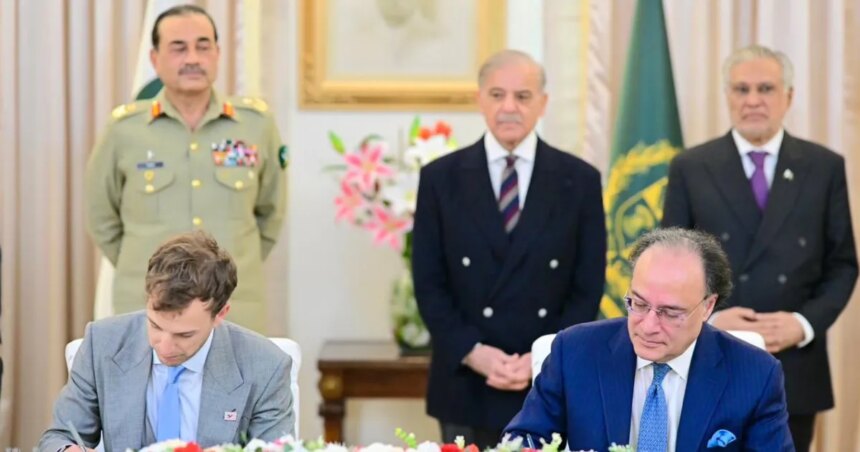
Among the early adopters of WLF’s offerings was Pakistan, which engaged with the firm earlier this year. In January, the Ministry of Finance of Pakistan entered into a memorandum of understanding (MoU) with SC Financial Technologies, a subsidiary of World Liberty Financial. This agreement aims to explore the application of WLF’s dollar-pegged stablecoin, designated as USD1, for facilitating cross-border payments. High-ranking officials, including Prime Minister Shehbaz Sharif and army chief Field Marshal Asim Munir, were present when the deal was formalized, with Trump advisor Zach Witkoff signing the agreement alongside Pakistan’s Finance Minister Muhammad Aurangzeb.
However, nearly six months post-signing, officials in Pakistan have indicated that there has been no pilot project initiated to utilize the USD1 stablecoin, and no licenses have been issued nor transactions executed using this digital currency. Despite this disconnect between the ceremonial signing and the actual execution of the MoU, analysts argue that Pakistan has gained invaluable access to the Trump administration, an achievement that contrasts sharply with the financial windfall Trump realized from WLF.
Stablecoins, like USD1, are digital currencies tethered to a stable value—commonly the US dollar—facilitating internet-based money transfers without banking intermediaries. WLF’s model generates revenue through interest on the cryptocurrency reserves, meaning increased utilization of USD1 benefits its owners, which includes the Trump family. Pakistan ranks among the largest markets for cryptocurrency globally; it was third in the Chainalysis crypto adoption index last year, trailing only behind India and the United States. Most informal crypto activities in the country are believed to be conducted via Tether’s USDT, the largest stablecoin on the market.
While USD1 has not been seen in any official transactions within Pakistan, the country’s remittance landscape remains robust. Pakistan recorded $38.3 billion in remittances in the last fiscal year, marking its highest total ever, an increase of 27% compared to the previous year. In May alone, official remittance inflows peaked at $4.25 billion, with expectations set for these figures to surpass $42 billion this year.
Despite this, the utility of stablecoins remains under scrutiny. Experts are questioning why individuals are resorting to USDT when formal banking channels for remittances are functioning efficiently. Ibrahim Khalil, a banking and finance professional based in Canada, highlighted that individuals might be avoiding these channels for various reasons, suggesting that USD1 will not eliminate these underlying issues.
Moreover, practical challenges arise from Pakistan’s monetary situation, where the central bank’s reserves only cover approximately two months of imports. For USD1 to be effective, it would need to be accepted by Pakistan’s trading partners. The central bank would then still face the need for converting the stablecoin back to dollars for use, potentially complicating transactions further.
In response to the burgeoning crypto landscape, Pakistan has enacted the Virtual Assets Act, which established a regulatory body—the Pakistan Virtual Assets Regulatory Authority (PVARA)—to oversee licensing and compliance within the crypto industry. While the State Bank of Pakistan has authorized banks to open accounts for licensed crypto firms, PVARA is still in the early stages of processing applications.
Many industry insiders remain cautious in their assessments of the World Liberty Financial agreement. Emphasizing that the MoU is more a matter of technical discussions than a commitment to any specific project, one senior banking executive noted that any compliant firm could fulfill the same regulatory role.
From a diplomatic standpoint, the motivations behind the agreement cannot be dismissed easily. The World Liberty Financial delegation’s visit to Islamabad occurred shortly after heightened tensions between India and Pakistan. Last year, Pakistan even nominated Trump for the Nobel Peace Prize for purportedly aiding in conflict resolution. The formalization of the MoU coincided with a period of strategic positioning for Pakistan, where it aimed to mediate in the escalating US-Iran tensions.
Bilal Bin Saqib, chair of PVARA, previously worked with WLF and was regarded as a contributor to rebuilding trust between Pakistan and the US, although he claimed no conflicts of interest existed.
Ultimately, while the tangible benefits of the arrangement concerning the welfare of Pakistani workers may be debatable, the access it grants to the US administration appears to be a significant takeaway for Islamabad. Khurram Husain, an economist from Karachi, described the MoU as an instrument of political access rather than a robust policy framework, asserting that this strategic engagement has been beneficial for Pakistan amid rising geopolitical complexities.