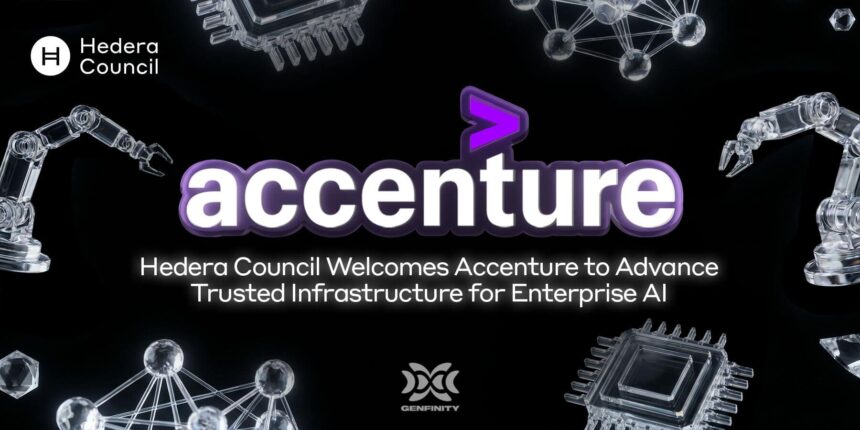
Accenture has officially secured a seat on the Hedera Council, marking a significant milestone in its partnership with the blockchain network. As a member, Accenture will operate a consensus node, participate in voting on network governance, and collaborate with other major players such as Google, IBM, McLaren Racing, and Dell to influence the direction of the Hedera ecosystem. This council membership not only signifies a deeper engagement with Hedera but also solidifies a long-term commitment to building infrastructure around verifiable AI governance tools, in collaboration with the Hedera Foundation and EQTY Lab.
According to Bryan Rich, Accenture’s global data and AI lead for health and public service, the current landscape necessitates a transformation in how enterprises manage trust, especially as they increasingly rely on AI agents capable of autonomous actions. He emphasizes the importance of having transparent and auditable systems to monitor these AI agents, which is a challenge that many regulated industries face today.
Mance Harmon, chairman of the Hedera Council, elaborated on the significance of Accenture’s involvement, stating, “As AI becomes more embedded in how organizations operate, building trust is becoming increasingly important.” He underscored that Accenture’s rich experience in guiding enterprises through transitions is invaluable to the council.
Unlike conventional blockchain governance models that often rely on token-based voting, the Hedera Council operates through a unique structure where each member organization enjoys an equal vote. This model fosters a balanced governance approach, ensuring that no single entity has unilateral control. Members run permissioned consensus nodes, approve protocol upgrades, and oversee treasury matters. The current council comprises up to 34 members from 11 diverse industries, reflecting a broad spectrum of expertise and perspectives.
As the urgency around the question of trust in AI grows, Accenture’s role on the council coincides with a wider trend across multiple sectors. Industries such as finance, healthcare, and government are deploying autonomous AI systems, meaning the need for accountability and oversight is more pressing than ever. Blockchain technology is increasingly seen as a potential solution, providing immutable logs of AI actions and real-time compliance verification, facilitating a reliable framework for regulation and oversight.
The implementation of Hedera’s network has proven capable of handling over 71 billion transactions, processing up to 10,000 transactions per second, and achieving an average finality of just under three seconds. Such performance metrics are particularly relevant for the logging of high-frequency AI agent activities.
Accenture is not merely joining the council as a passive observer; it aims to actively contribute by leveraging its existing partnership with EQTY Lab. Together, they are working on implementation strategies that involve tools like the “AI Guardian,” which generates tamper-evident attestations for AI actions and stores them on Hedera’s blockchain, thereby establishing a permanent and transparent audit trail. This technology was featured in a demonstration at NVIDIA GTC DC, illustrating how emergency management personnel could utilize AI-driven insights in real time.
Accenture’s ambitions extend beyond public sector applications, with a keen interest in exploring how its Hedera-based innovations could benefit financial services, particularly in areas such as digital asset tokenization and AI-driven payment solutions. These applications necessitate the type of transparent and auditable infrastructure that Hedera’s governance model is designed to support.
The increasing overlap between blockchain technology and AI is rapidly evolving from a theoretical discussion to actionable plans in enterprise technology. Businesses are moving past hesitant inquiries regarding the necessity of oversight for autonomous AI systems to focusing on how to effectively implement infrastructure solutions capable of accommodating these technologies.
In early 2026, the market capitalization of Hedera’s stablecoin shot up by nearly 92%, reflecting growing confidence in its infrastructure. Since its inception, the Hedera Council has expanded significantly, illustrating a mounting interest in this blockchain network as a viable platform rather than a preliminary experiment.
Accenture’s engagement in the Hedera Council not only enhances its own position in guiding major corporations and government entities through digital transformation but also grants the firm substantial leverage in shaping the future of a network that is increasingly perceived as the backbone for trust in AI. As enterprises continue to adopt AI as an essential tool, the demand for transparent and reliable governance frameworks will become paramount, positioning blockchain networks capable of meeting these needs at the forefront of technological advancement.