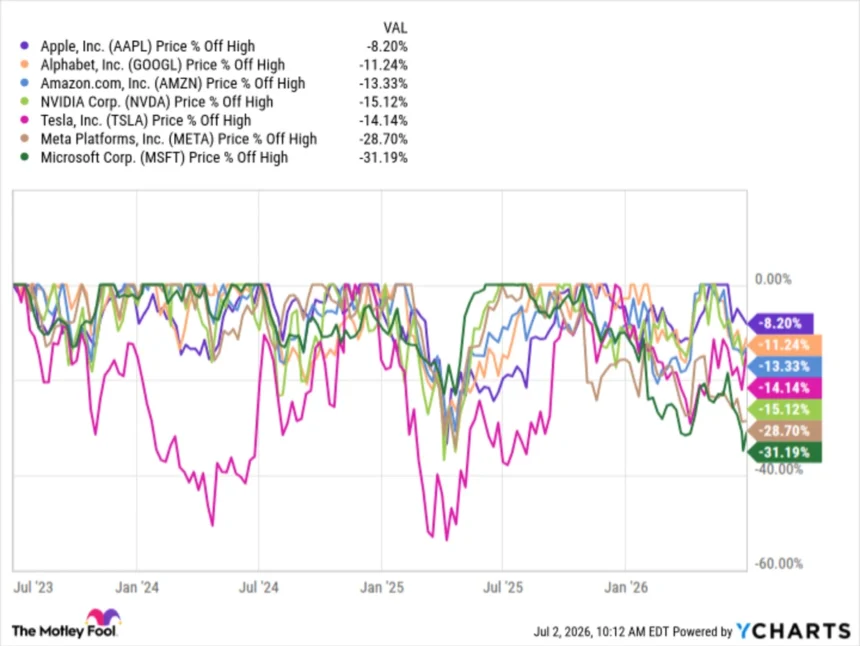
In recent years, the surge in artificial intelligence (AI) has significantly boosted stock market performance, particularly for a select group of tech giants dubbed the “Magnificent Seven.” However, new data suggests that the rally tied to these companies may be reaching its limits, indicating a potential shift for investors.
As of mid-2026, all seven of these influential stocks, representing key players in the AI field, have experienced declines over the past three years. Notably, the only exception is Apple, which has managed to maintain stability in its stock price. Alphabet has shown a slight recovery, yet the overall trend suggests a cooling in what has been a hot market segment.
Historical comparisons are being drawn to the financial landscape of 2009, when a “Double Down” signal emerged for Nvidia, a less prominent chipmaker at the time. Currently, a similar “Total Conviction” indicator is appearing for a company that is notably smaller than Nvidia, raising curiosity among investors about potential lucrative opportunities that may emerge in less-traveled paths.
In light of the recent underperformance of growth stocks and the notable changes in market dynamics, many investors are advised to shift their strategies toward more defensive and relatively inexpensive options. This could involve an emphasis on quality stocks—companies that boast robust balance sheets and substantial cash flow. These firms are typically structured to endure varying economic climates, making them more resilient during challenging market phases.
Given the difficulty of selecting promising individual stocks, one recommended strategy is to consider investing in an exchange-traded fund (ETF) that includes a diversified range of these high-quality companies. The Invesco S&P 500 Quality ETF, for example, is characterized by a significant 42% allocation to technology, reflecting the continued growth potential within that sector, while also diversifying its holdings with 15% to 20% allocations in industrials and financials, as well as a substantial exposure to consumer staples.
This ETF strategy is further enhanced by its balanced focus on large-cap stocks (approximately 80%) alongside mid-cap and small-cap stocks (around 20%). This diversity not only aligns well with broader market indices like the S&P 500 but also offers a buffer against potential market downturns.
Amid these market fluctuations, experts caution against panic-induced selling. Instead, they advocate for a concentrated focus on high-quality companies known for weathering past adversities.
For those contemplating an investment in the Invesco S&P 500 Quality ETF, it’s worth noting that it has not featured in the latest recommendations from a well-regarded investment advisory team, which recently highlighted what it sees as ten superior stocks poised for significant returns. The track record of these recommendations is impressive, with some historical picks yielding remarkable returns, such as Netflix and Nvidia.
Investors are encouraged to evaluate these opportunities critically while remaining mindful of the overall market environment and potential volatility ahead.