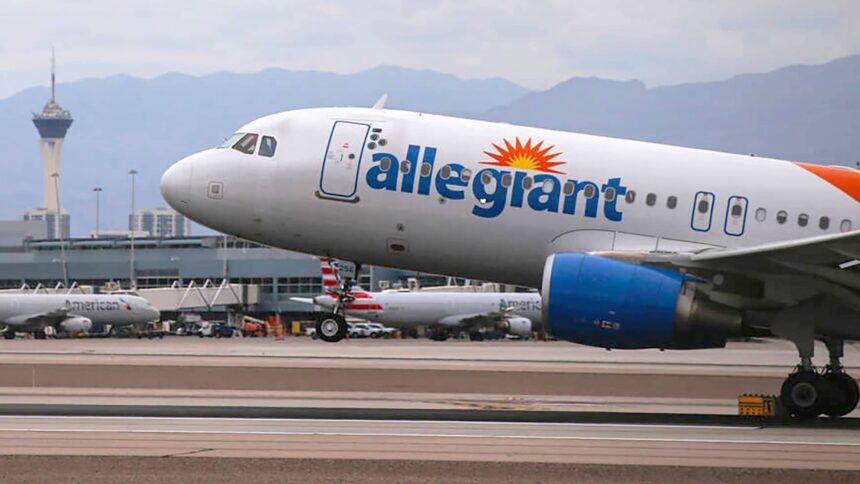
Allegiant Travel Co. has successfully finalized its acquisition of Sun Country Airlines, signaling a significant shift in the airline industry amid ongoing challenges such as skyrocketing jet fuel prices. The deal, valued at approximately $1.5 billion in cash and stock, including debt, was announced earlier this year and officially closed on Wednesday. Greg Anderson, the CEO of the newly combined entity, emphasized that while market conditions may be turbulent, Allegiant Air will maintain its unique business model.
In an interview with CNBC, Anderson stressed that the corporation’s strategy is designed to safeguard profit margins rather than aggressively pursuing expansion. Current plans will keep the brands and booking platforms of Allegiant and Sun Country distinct, at least in the short term. The merger is expected to allow the integrated airline to operate approximately 650 routes across 175 cities.
Reflecting on the operational approach, Anderson highlighted a calculated capacity growth strategy that has shielded the airlines from some of the industry disruptions that have affected other low-cost carriers. He noted that the airline intends to ramp up its services during peak travel seasons, such as summer and spring break, while reducing capacity during lower-demand periods. For instance, the airline may reduce its fleet operations significantly on less busy travel days, like Tuesdays in September.
Both Allegiant and Sun Country aim to cater to budget-conscious travelers, offering connections from smaller cities to popular vacation destinations. Notably, Sun Country has also been providing cargo services for major clients like Amazon, diversifying its revenue streams.
Despite recent dramatic increases in jet fuel prices—caused in part by geopolitical tensions in the Middle East—Anderson reported that demand among their value-focused leisure customers remains strong. The airline industry is currently grappling with billions in additional costs linked to these fuel price surges, which have roughly doubled since February. Jet fuel expenses are typically the second-largest cost for airlines, trailing only labor costs. Many airlines have already started raising fares to counterbalance these heightened expenses.
As part of their efforts to address the rising fuel costs, the Association of Value Airlines, encompassing both Allegiant and Sun Country, recently requested $2.5 billion from the Trump administration for relief. However, Transportation Secretary Sean Duffy indicated that he does not believe such measures are warranted.
Allegiant has reported a profit of $42.5 million for the first quarter of this year, marking a 32% increase from the same period a year prior. Analysts from Raymond James noted that this indicates the viability of certain low-cost operational models. The acquisition arrives at a time when the airline industry recently saw a significant setback with the shutdown of Spirit Airlines, marking the largest airline collapse in the U.S. in recent history.
While specific financial forecasts for the newly expanded company have not been made public, Allegiant has anticipated a capacity decrease of approximately 6.5% in the second quarter compared to last year, with third-quarter capacity expected to remain steady or decrease slightly.
In the context of an industry dominated by major players such as Delta Air Lines, American Airlines, United Airlines, and Southwest Airlines—who collectively control around 80% of the domestic market—Allegiant and Sun Country are carving out their niche by focusing on leisure travelers and smaller, underserved markets.