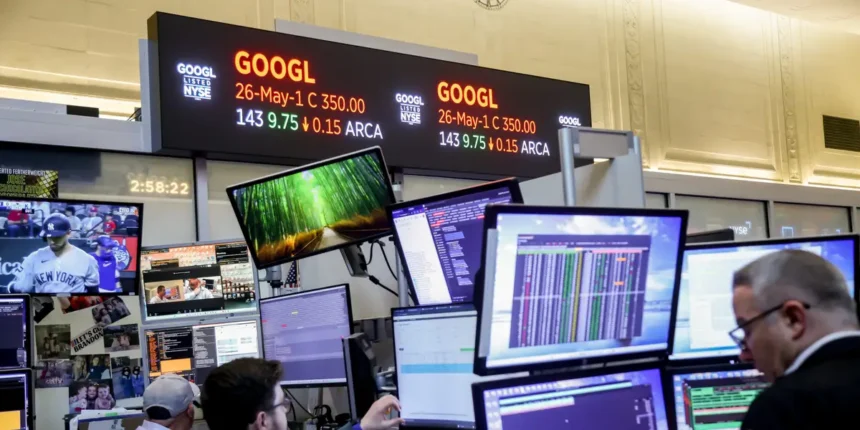
In a significant move reflecting the evolving landscape of the stock market, tech giant Alphabet has officially joined the Dow Jones Industrial Average, taking the place previously held by Verizon. This development raises an intriguing question: how has Alphabet, one of the world’s leading tech companies, not been a part of this prestigious index until now?
Market observers often criticize the Dow for being slow to adapt to significant market trends, particularly the growing prominence of technology companies. While companies like Microsoft, Apple, Amazon, and Nvidia have already secured their spots in the index, Alphabet’s entry suggests that the Dow is finally acknowledging the impact of AI-driven technology on investing. Despite previous delays, the addition of Alphabet marks a watershed moment for the index as it begins to realign with current market dynamics.
As the second-most-valuable company globally, boasting a market capitalization exceeding $4 trillion, Alphabet’s influence on the market is undeniable. However, it’s essential to understand how its inclusion will affect the index and the broader investing landscape.
Unique to the Dow is its methodology for calculating weight, which differs from the market-cap-weighted S&P 500. Alphabet, with a share price of $337.39 as of Friday’s close, will rank as the sixth-largest constituent in the Dow despite its staggering valuation. It will represent approximately 4% of the index, which is lower than its 6% stake in the S&P 500—an index that encompasses roughly 500 companies—and an even smaller share of 8% in the tech-centric Nasdaq 100.
The comparatively diminished influence of Alphabet within the Dow might be beneficial, particularly as the Nasdaq 100 often exhibits volatility tied to the latest trends in AI investment. Unlike indexes such as the S&P 500, the addition of a stock like Alphabet to the Dow is primarily symbolic. Only limited investment vehicles, primarily the SPDR Dow Jones ETF (DIA), track the index, which has a total market value around $45 billion. In contrast, nearly $3 trillion is invested in funds linked to the S&P 500, leading to much more pronounced price movements when companies are added to it.
Some investors may perceive Alphabet’s addition to the Dow as a contrarian indicator. There is a prevailing sentiment that if the Dow is now recognizing a theme like artificial intelligence as fundamental to the market, it may suggest that the peak of this trend has already passed. Historical patterns have shown that the Dow can often serve as a lagging indicator, reflecting past market conditions rather than forecasting future trends.
As Alphabet steps into this new role within the Dow Jones Industrial Average, the implications for investors and the tech landscape are substantial. The move signifies a newfound acknowledgment of the critical role that technology plays in the modern economy. Whether this shift will spark further transformation in how the Dow tracks the market remains to be seen, but it is undoubtedly a pivotal moment in the index’s long history.