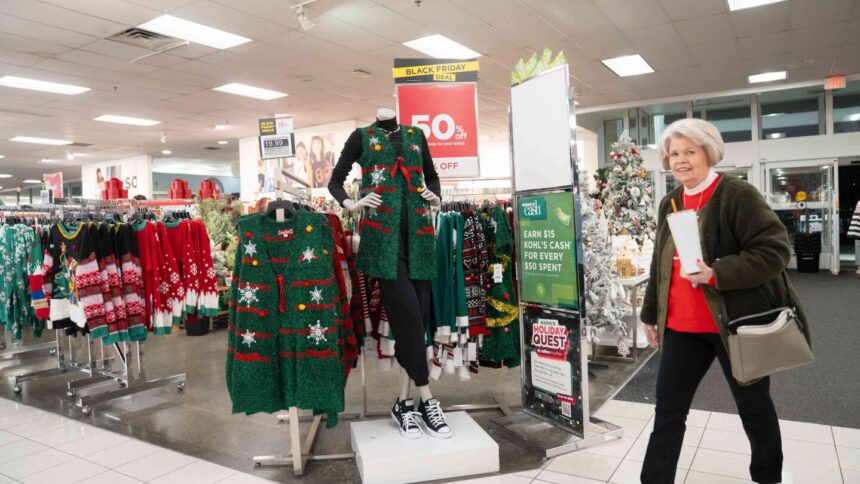
This holiday season presents a challenging landscape for American shoppers, with many resorting to savings, hunting for bargains, and largely feeling that the economy is stagnant under the current administration. A recent AP-NORC poll highlights that a significant majority of U.S. adults have noticed rising prices for basic necessities like groceries, electricity, and holiday gifts in recent months. Nearly half of Americans report it is more difficult than usual to afford holiday gifts, leading many to postpone significant purchases or reduce spending on nonessential items.
These findings pose a challenge for President Donald Trump, who gained support largely by promising to combat rising prices. However, inflation continues to be a concern, echoing sentiments observed during the presidency of Joe Biden, suggesting that economic issues transcend party lines. Trump’s implementation of tariffs has compounded inflationary pressures, eliciting frustration among the public. While the president maintains that the economy is robust and inflation is nonexistent, the majority of adults—68%—rate the economy as “poor,” a figure consistent with sentiments from December 2024.
Amid rising costs, the White House is strategizing to boost consumer confidence ahead of the upcoming midterm elections, with plans for the president to travel across the country. In a recent address in Pennsylvania, Trump suggested that Americans might need to reconsider their holiday spending habits, a message starkly at odds with the sentiments expressed in the poll. Many respondents, including some who supported Trump in the past, are adjusting their shopping strategies, seeking lower prices more diligently than usual.
Sergio Ruiz, a voter who leaned towards Trump, shared his experience of utilizing buy-now-pay-later programs to manage gift expenses for his children, suggesting a need for higher incomes to better handle rising prices. The survey reveals that half of Americans are actively seeking lower prices while a substantial number are navigating their budgets more cautiously. Notably, Democrats are more likely than Republicans to report cutting back on spending, although many Republicans are also adjusting their shopping habits.
Consumer confidence remains fragile as inflation has eased somewhat since its peak, but current rates still exceed the Federal Reserve’s target. The poll illustrates a widespread acknowledgment of elevated prices; 87% of adults have noted higher grocery costs, and around two-thirds report increased prices for electricity and holiday gifts.
Despite the pressures, overall consumer spending has demonstrated resilience. However, individuals like Andrew Russell have adapted their purchasing habits due to the economic climate and tariffs, opting for local shopping rather than international online purchases.
Looking ahead, optimism for a significant economic rebound is scarce, with approximately 40% of U.S. adults anticipating worse conditions in the coming year. Concerns about the effects of tariffs, tax changes, and other policy measures are prevalent, with many citizens expressing skepticism about the potential benefits of Trump’s economic strategies materializing in the near future.
As sentiments shift, those reliant on government assistance express apprehensions about worsening conditions, with some attributing their struggles to the current administration’s policies. The poll results underscore a growing disconnect between the administration’s messaging and the lived experiences of everyday Americans as they navigate the challenges of the current economic landscape.