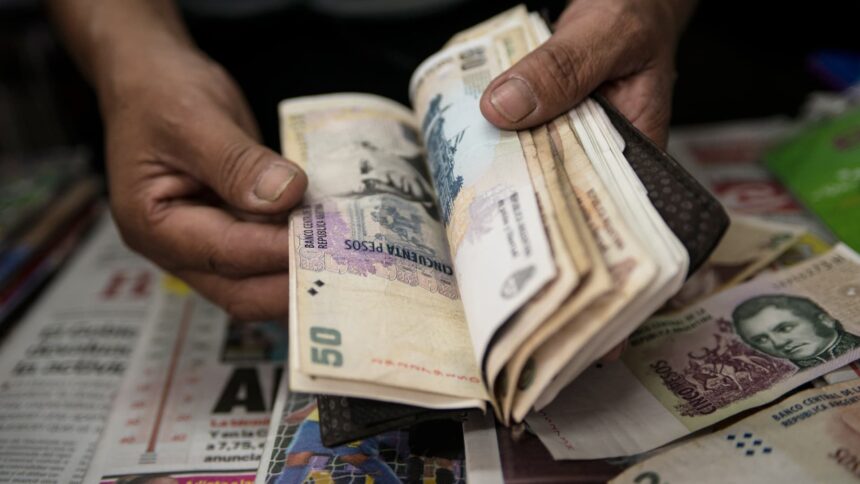
The Argentine peso plunged to new lows on Wednesday, continuing a downward trajectory as political uncertainty compounds existing economic challenges. The currency fell to its lowest point since the U.S. began its intervention on October 9, marking a striking decline despite a significant billion-dollar support package from the United States.
This intervention is part of a broader strategy to stabilize Argentina’s weakening currency as the nation approaches critical midterm elections on October 26. President Javier Milei, an ally of former U.S. President Donald Trump, is navigating a precarious political landscape where the left-wing Peronist parties pose a significant threat.
The U.S. has not only engaged in purchasing the peso but has also formalized a $20 billion currency swap agreement with Argentina’s central bank. This arrangement allows for the exchange of stable U.S. dollars for the more volatile Argentine pesos. However, the peso has dropped over 5% since the intervention began, with its value reaching a fresh low of about 1,490 pesos per U.S. dollar early on Wednesday. Despite some recovery later in the day, the peso was still trading approximately 0.3% lower against the dollar by early afternoon in London.
Analysts suggest that the peso’s fluctuating value is more closely tied to electoral expectations rather than the U.S. support alone. According to Sergi Lanau, director of global emerging markets strategy at Oxford Economics, significant market fluctuations occur whenever there are indications of a strong performance from Peronist factions. He emphasized that while interventions can provide temporary support, the central bank’s actions have not resulted in substantial changes to the peso’s trajectory amid high levels of electoral uncertainty.
Historical context reveals that Peronist governments, named after former President Juan Perón, are often associated with policies that induce high inflation and erode confidence in the peso. Although Milei’s administration is attempting to counter these systemic issues, the trade-offs involved may lead to short-term economic instability. Allegations of corruption against Milei’s inner circle have also rekindled fears of a possible return to Peronist governance, which perpetuates inflationary tendencies.
In response to the escalating financial crisis, U.S. Treasury Secretary Scott Bessent highlighted the critical nature of Argentina’s situation, stating that the country is experiencing “acute illiquidity.” He asserted the necessity of a unified international approach to support Argentina’s stringent fiscal strategy while emphasizing that the U.S. is uniquely positioned to deliver prompt market stabilization.
Gustavo Medeiros, head of global macro research at Ashmore, labeled the support package as “pretty unprecedented.” He inferred that Argentina is not grappling with a fiscal sustainability issue but rather a liquidity crisis. Medeiros pointed out that establishing a mechanism for the government to buy back its bonds in the secondary market could be a strategic move to alleviate debt levels.
As Argentina confronts these economic headwinds, the outcome of the upcoming elections could significantly influence the peso’s future and the nation’s financial stability in the long run.