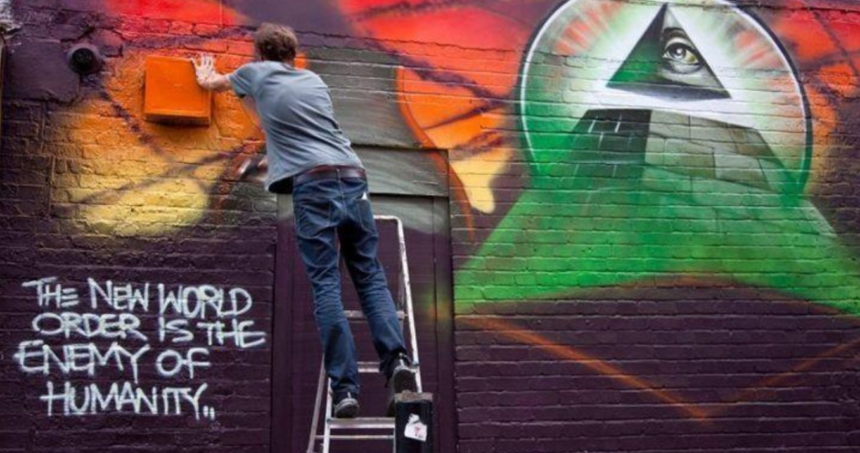
Revolutions often leave behind more than just the standard symbols of upheaval; they can also encompass the quieter, more profound artifacts that encapsulate a significant shift in consciousness. Items such as a wheat-pasted broadside displayed on a Los Angeles overpass, a hand-lettered sign outside a Tokyo office in the snow, or a newspaper headline that has been permanently woven into software challenging global finance epitomize this transformative spirit.
The exhibition “ relics of a revolution,” held at the Bitcoin 2026 Conference in Las Vegas, showcases art that serves as a tangible link between grassroots protest and the emerging world of Bitcoin. Central to this exhibition is Mear One, a Santa Cruz-born artist whose activist roots trace back nearly forty years. He was a pivotal figure in the Melrose graffiti art movement of the late 1980s and was also the first graffiti artist to present at influential galleries such as the 01 Gallery and the 33 1/3 Gallery. His career reflects a journey from anti-war sentiments during the Gulf War in the early ’90s to the zeitgeist of the Occupy Wall Street movement in 2011. Mear One’s works argue that the core problem lies not with individual politicians but rather with the very architecture of money and power itself.
In a recent conversation, Mear One illuminated the motivations behind his street art practice during a time when graffiti was widely criminalized. To him, graffiti embodied the voice of the dissatisfied, serving as a means to reach the public long before social media became ubiquitous. He describes the act of tagging public spaces as both invigorating and defiant, serving to highlight systemic failures while fostering a sense of community among urban dwellers.
Mear One also connected the artistic and ideological underpinnings of his work to Bitcoin. He noted that the origins of Bitcoin echoed the anti-establishment sentiments of graffiti, hip hop, and punk culture, reflecting a collective desire to break free from oppressive systems. He views various economic and political struggles, including wars and the thrill of profit-seeking, as interconnected. In his philosophy, the architects of the current financial system are often the same forces responsible for perpetuating social issues, and he argues that fundamental human desires for freedom, love, and connection remain overshadowed by the power dynamics at play.
Reflecting on his participation in the Be the Revolution tour in 2004, alongside prominent artists like Shepard Fairey, he emphasized the importance of using art to challenge and resist political and economic injustices. The 2008 financial crash prompted a significant shift in his artistic lens, igniting a deep curiosity about monetary systems and leading to the creation of his most provocative work, “False Profits.” He passionately asserts that art can wield transformative power, encouraging people to confront uncomfortable truths about their societal structures.
Despite the ephemeral nature of street art—often subject to being erased or painted over—Mear One’s work endures. He interprets its survival in gallery spaces as a testament to the ongoing relevance of its messages, suggesting that the underlying issues of systemic inequity have yet to be resolved. With the current geopolitical landscape mirroring historical patterns of conflict he addressed through his art, he remains committed to calling out these cycles of oppression.
Discussing Bitcoin within the context of socio-economic upheaval, Mear One sees it as a potential tool for liberation, though he acknowledges its complexities and the internal struggles faced by the Bitcoin community. He perceives Bitcoin not as an ultimate solution but as a crucial initial step toward freeing society from the limitations of fiat currency. He encourages a continued exploration of innovative ideas that could reshape future realities.
Mear One’s first encounter with Bitcoin came through an unexpected conversation with a mathematician, which ultimately led him to explore the community at Anarchapulco. There, he found a shared sense of resistance and purpose, and he successfully transitioned into the digital art space by accepting Bitcoin for his work.
As part of the exhibition “Relics of a Revolution,” Mear One’s artifacts stand alongside a pivotal newspaper from the inception of Bitcoin. This juxtaposition symbolizes how artistic expression can meld with revolutionary technology to forge new paths toward freedom. He views the artworks displayed not merely as relics, but as calls to action, urging viewers to understand the significance of revolution in all its forms, intertwined eternally with the quest for freedom from systemic control.
In a world fraught with economic destruction and conflict, Mear One posits that the struggle against oppressive financial systems is paramount. He champions not merely the artworks of the past but encourages a patronage model that supports cultural preservation and artistic endeavors. As the discourse around Bitcoin continues to evolve, he remains hopeful that it will contribute to a broader spiritual awakening of humanity, advocating for a future where concepts of money may become obsolete.