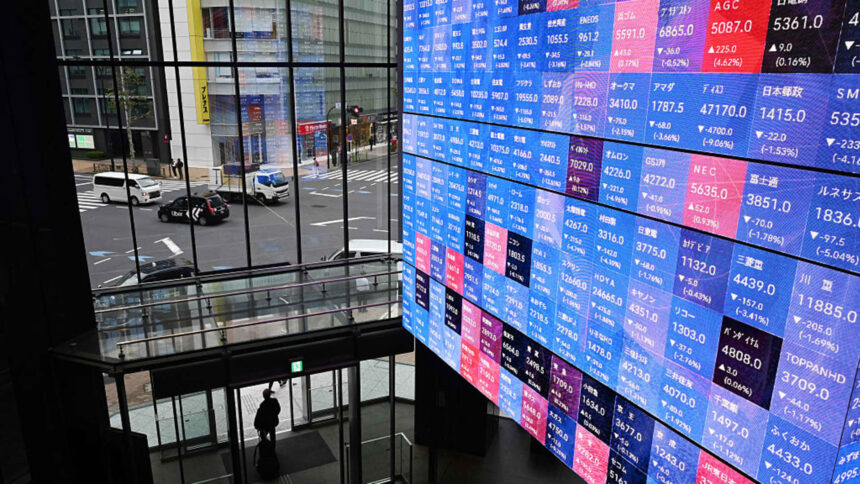
Asia-Pacific markets experienced a downward trend on Tuesday as investors grappled with renewed uncertainty surrounding U.S.-Iran peace negotiations, despite Wall Street’s benchmark indexes reaching new heights the previous day, buoyed by optimism in the technology sector.
Japan’s Nikkei 225 index began the day by declining by 0.52%, while the broader Topix index saw a more significant drop of 0.98%. South Korea was not spared from the market’s negativity, with the Kospi falling by 0.32% and the smaller-cap Kosdaq experiencing a sharper downturn of 2.5%. In Australia, the S&P/ASX 200 index reported a decrease of 0.67%. Futures for Hong Kong’s Hang Seng index were also reflective of the trend, trading lower at 25,207, underperforming its last close of 25,398.18.
The backdrop for these declines included statements from U.S. President Donald Trump, who expressed indifference toward the ongoing peace talks with Iran. In a phone interview with CNBC, Trump downplayed the importance of the discussions, saying, “I don’t care if they’re over, honestly… I really don’t care. I couldn’t care less.” His comments were made in reaction to reports that Iranian negotiators might consider halting talks with the U.S. and were contemplating actions in response to Israeli military operations against Iran-backed Hezbollah in Lebanon.
Responding to inquiries about whether Iranian officials had communicated to him their intent to cease negotiations, Trump stated, “No, they haven’t.”
As for U.S. futures, the S&P 500 experienced a slight dip of 0.2%, while Nasdaq 100 futures fell by 0.3%. Futures associated with the Dow Jones Industrial Average also decreased, losing 122 points or roughly 0.2%.
However, U.S. markets had enjoyed a robust performance overnight. The S&P 500 edged up by 0.26% to close at 7,599.96, while the Nasdaq Composite saw a 0.42% rise, ending at 27,086.81. The Dow Jones Industrial Average added 46.42 points, or 0.09%, for a closing value of 51,078.88. Notably, all three indexes achieved new all-time intraday highs and concluded the session at record levels, driven largely by strong performances from major technology firms such as Nvidia, which introduced a new chip for personal computers.
As traders and investors navigate these volatile waters, the markets remain sensitive to geopolitical developments, particularly those involving the U.S. and Iran, showcasing how international relations can significantly influence economic sentiment.