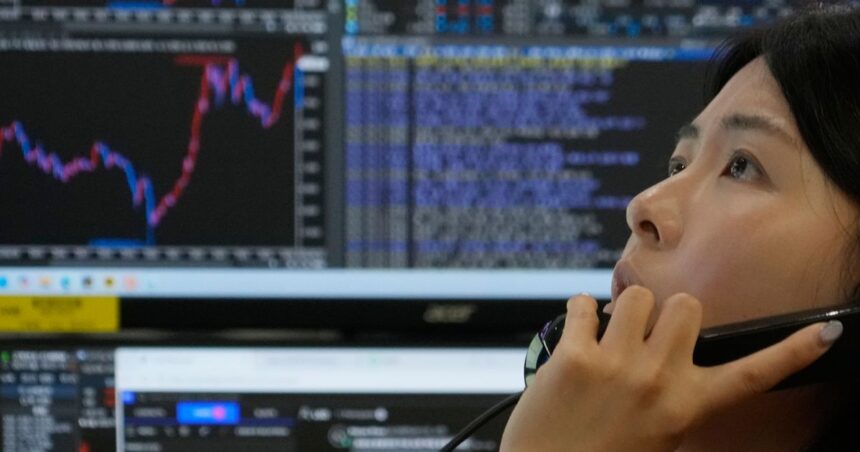
Stock markets in Japan and South Korea achieved fresh record highs on Monday, fueled by enthusiasm surrounding the artificial intelligence (AI) boom and an anticipation of developments regarding a ceasefire extension in the ongoing Iran conflict.
In the commodities market, oil prices rose over 2% as negotiations between the U.S. and Iran continued, particularly concerning the reopening of the Strait of Hormuz, a crucial maritime route for global oil and natural gas shipping.
U.S. futures showed a modest uptick, reflecting the overall positive sentiment in global markets.
Asian shares generally advanced, with Japan’s Nikkei 225 and South Korea’s Kospi reaching unprecedented highs during the trading session. These gains were predominantly driven by technology-related stocks, as investors remained optimistic about sustained growth in AI and other advanced technologies.
Japan’s Nikkei 225 climbed more than 1.3%, surpassing the 67,000-point mark for the first time, achieving a level of 67,231.28. Shares of SoftBank Group, which has heavily invested in AI, surged over 9% following strong performance in the previous week.
Meanwhile, South Korea’s Kospi index saw a nearly 5% spike, hitting an all-time high of 8,874.16. Samsung Electronics, the nation’s largest company, recorded over a 9% increase. Recent data indicated that South Korean exports surged by 53% year-on-year in May, largely attributed to robust global demand for semiconductors.
Over the past month, the Nikkei 225 has risen more than 12%, while the Kospi has soared over 27%.
In Hong Kong, the Hang Seng index was trading 0.9% higher at 25,408.96. Conversely, the Shanghai Composite index experienced a slight decline of 0.1%, closing at 4,063.72, following reports that factory activity in China softened in May, signaling a slowdown in new export demand.
The S&P/ASX 200 in Australia dipped by 0.1%, settling at 8,720.30, while Taiwan’s Taiex climbed 1.4% and India’s Sensex gained 0.6%.
Despite the rally in Asian stock markets, uncertainties surrounding the potential for a permanent resolution to the Iran war continue to influence market dynamics and contribute to volatility in oil prices. The conflict has persisted for three months, with markets reacting to both geopolitical concerns and optimistic trends in AI demand and corporate earnings.
On Friday, U.S. President Donald Trump engaged in high-level discussions but did not finalize plans for a tentative extension of the Iran war ceasefire by an additional 60 days. Iran has indicated that no agreement has been reached yet, and discussions about reopening the Strait of Hormuz have yet to yield results, as the U.S. maintains a blockade on Iranian ports.
Brent crude, the international oil benchmark, increased by 2.4% to $93.33 per barrel, significantly up from approximately $70 in late February prior to the onset of the war. Benchmark U.S. crude saw a rise of 2.8%, reaching $89.76 per barrel.
In the U.S., stock indices reached new milestones last week, buoyed by strong performances from major technology companies. The S&P 500 recorded a 0.2% increase, achieving seven consecutive gains to reach 7,580.06. The Dow Jones Industrial Average advanced 0.7% to 51,032.46, while the tech-heavy Nasdaq composite rose by 0.2% to 26,972.62.
Among notable movements, Dell Technologies surged by an impressive 32.8% following results that surpassed expectations and a raised outlook driven by strong demand for AI-related products. Microsoft and Broadcom also saw significant gains, rising over 5.4% and 4.7% respectively.
In currency markets, the U.S. dollar strengthened against the Japanese yen, climbing to 159.48 from 159.25, while the euro traded at $1.1645, down slightly from $1.1667.