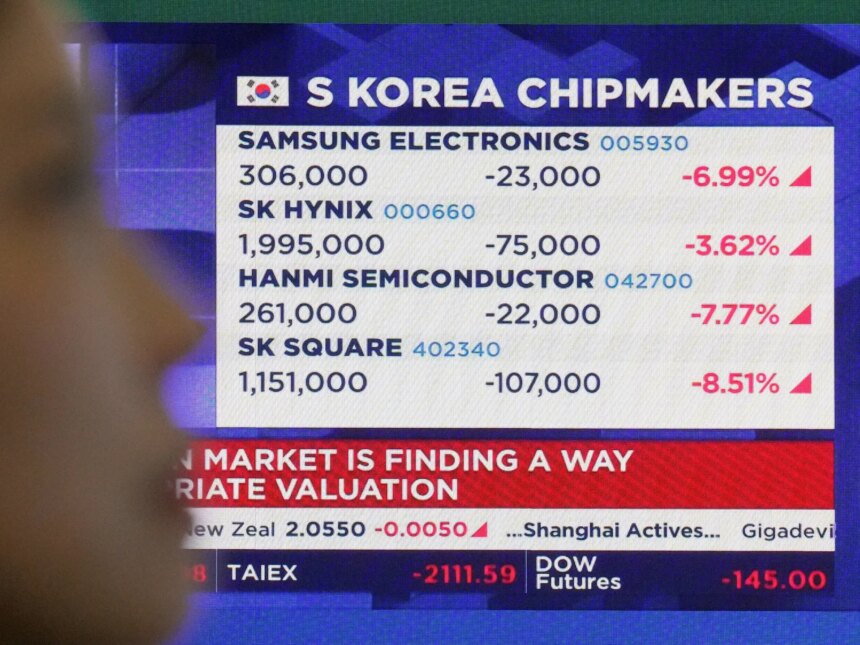
Asia’s major stock markets experienced a significant downturn, largely attributed to escalating tensions between Iran and Israel, along with rising expectations for interest rate hikes in the United States. On Monday, South Korea’s KOSPI index plunged nearly 9 percent, marking the steepest losses among the region’s markets. This decline triggered the exchange’s circuit breaker for the second time this year, previously activated in March when the index fell 12.06 percent.
As trading resumed, the KOSPI ultimately closed 8.29 percent lower, despite being the top-performing major index earlier in 2026. Major tech firms, including Samsung Electronics and SK Hynix, bore the brunt of the losses, with shares plummeting by 10.2 percent and 7.6 percent, respectively.
Across Asia, other stock markets were not immune to the sell-off. Japan’s Nikkei 225 index dropped 3.9 percent, while Taiwan’s TAIEX, heavily influenced by semiconductor giant TSMC, fell 3.5 percent. In mainland China, the SSE Composite Index decreased by 1.7 percent, and Hong Kong’s Hang Seng Index dropped 1.3 percent.
The turmoil in the markets coincided with a notable rise in Brent crude oil prices, which surged 3.7 percent to surpass $88.50 a barrel. The rise in oil prices, combined with renewed geopolitical tensions, likely heightened investor anxiety.
The sell-off follows last week’s market movements in the U.S., driven by unexpectedly strong jobs data that intensified concerns about potential interest rate hikes by the Federal Reserve. Wall Street’s major indexes all suffered declines, with the tech-heavy Nasdaq Composite experiencing its worst day since April 2025, falling 4.18 percent.
Market analysts noted that the substantial declines were a response to a recent correction in U.S. tech stocks, particularly favoring non-farm payroll figures. As Fabien Yip, an analyst at IG Group, indicated, the fallout from dwindling optimism in the AI market particularly impacted technology stocks across Asia, many of which had seen exceptional growth in recent months. Additionally, the weakening South Korean won and potential tightening of policies in Korea could further strain leveraged positions in the domestic market, exacerbating the volatility.