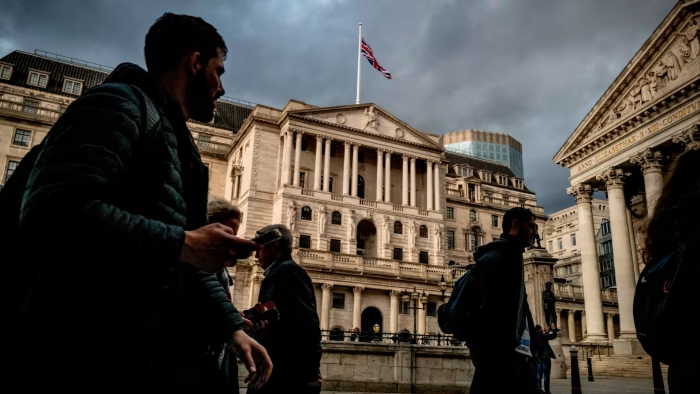
In a closely watched decision, the Bank of England has opted to maintain its key interest rate at 4 percent, reflecting a delicate balance amid concerns over a faltering labor market and ongoing inflation pressures. The Monetary Policy Committee (MPC) cast its votes on Thursday, revealing a tight split of five to four in favor of keeping borrowing costs steady. This marks the end of a series of five rate cuts initiated since the summer of 2024.
Recent statements from the MPC suggest that inflation in the UK may have peaked, with indications pointing toward gradual rate reductions in the near future. Francesco Pesole, an FX strategist at ING, remarked that the narrow vote specifies a low threshold for a potential rate cut in December. He noted that the MPC’s assessment regarding inflation appears increasingly dovish.
The Bank’s updated economic projections predict a decline in inflation from the current rate of 3.8 percent, which is nearly double its target, to a more manageable 2 percent by the fourth quarter of 2027. Additionally, GDP growth expectations have been downgraded, forecasted to slip from 1.5 percent this year to 1.2 percent by 2026, followed by a revival to 1.6 percent in 2027 and 1.8 percent in 2028.
Governor Andrew Bailey was among those who voted to keep the policy unchanged, while some members of the committee advocated for an immediate rate cut. Meeting minutes indicated that Bailey remains open to the possibility of a rate reduction as soon as December, contingent upon forthcoming economic data and the upcoming budget announcement from Chancellor Rachel Reeves on November 26.
In a statement following the meeting, Bailey emphasized the need for confirmed trends in inflation before any further cuts could be implemented. “We still think rates are on a gradual path downwards, but we need to be sure that inflation is on track to return to our 2 percent target before we cut them again,” he stated.
Post-decision, the British pound experienced a slight dip but quickly rebounded, trading 0.3 percent higher against the dollar at $1.309. Concurrently, the yield on UK government two-year bonds fell by 0.02 percentage points to 3.79 percent, reflecting shifts in interest rate expectations.
Chancellor Reeves underscored that fiscal discipline and a commitment to controlling costs would facilitate future interest rate reductions. “Today’s forecast shows that inflation is due to fall faster than previously predicted,” she noted, hinting at a Budget that might include tax increases aimed at reducing government borrowing while establishing strong economic foundations.
Four members of the MPC—including Deputy Governors Sarah Breeden and Dave Ramsden, alongside external members Swati Dhingra and Alan Taylor—voted in favor of a quarter-point cut to 3.75 percent. Meanwhile, Bailey, supported by Deputy Governor Clare Lombardelli, Chief Economist Huw Pill, and external members Megan Greene and Catherine Mann, opted for the status quo.
For the first time, the Bank of England has provided individual statements outlining each rate-setter’s policy outlook. Bailey’s personal statement indicated an inclination to pursue rates cuts if disinflation becomes more convincingly established. He remarked that market rate expectations, currently forecasting a leveling out at around 3.5 percent next year, appear to be a “fair description” of his outlook.
However, he stressed the importance of awaiting another month’s worth of economic data before committing to any changes, particularly in relation to upcoming inflation and employment reports, as well as the implications of Reeves’ Budget. As market analysts await the Bank’s next meeting on December 18, the decision effectively reflects a cautious stance, balancing the need for economic stimulus against the pressing challenges of inflation.