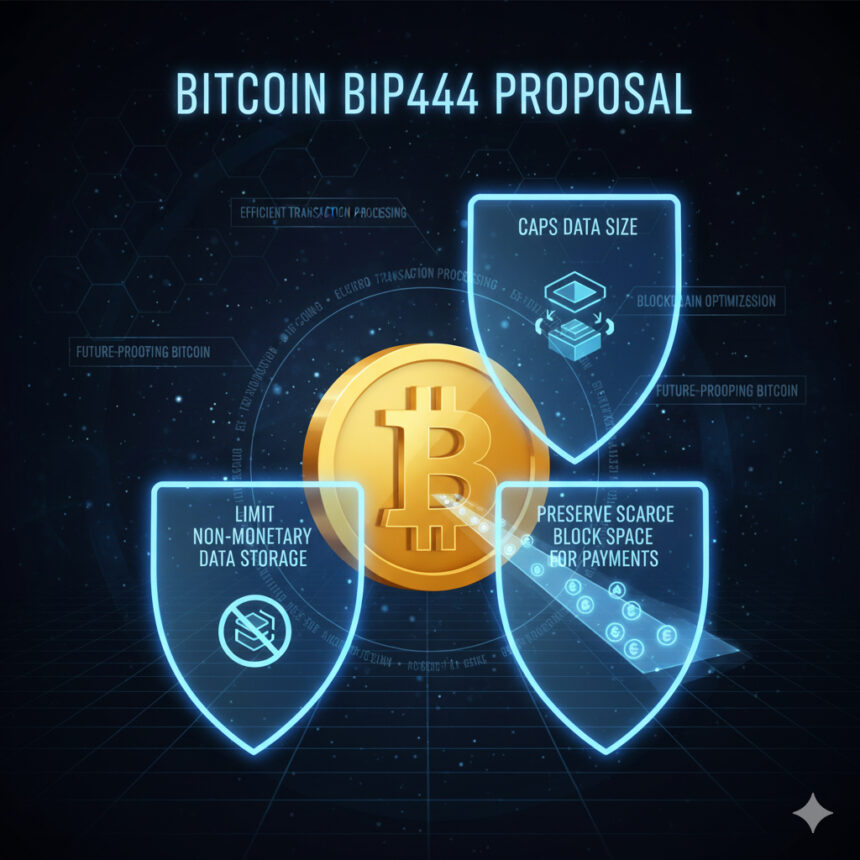
A new proposal known as BIP-444 is making waves within the Bitcoin community, advocating for a temporary soft fork to impose strict limits on non-monetary data storage on the Bitcoin network for approximately one year. This initiative arises from recent discussions surrounding Bitcoin’s changing dynamics and its capacity for handling various types of data.
The proposal introduces a significant cap on data size, effectively barring large inscriptions such as Ordinals. By doing so, it aims to foster the preservation of limited block space specifically for payment transactions. The Bitcoin community finds itself at a crossroads, grappling with the fundamental question of Bitcoin’s primary purpose: should it be viewed as a money network or as a censorship-resistant ledger accommodating all forms of data?
BIP-444 comes in the wake of the adoption of Bitcoin Core v30, which facilitated the removal of the byte cap for OP_RETURN data, provided that requisite fees are covered. Current data indicates that only about 6.3% of reachable nodes are operating on this latest version, as reported by Bitnodes.
The essence of BIP-444 is to halt large data transactions temporarily. The proposal intends to restrict allowed non-monetary data to minimal sizes, essentially limiting it to “short notes” rather than allowing for extensive data files or images. As a soft fork, the initiative requires a sufficient number of nodes to implement the new regulations, after which transactions containing oversized data would be rejected by those upgraded nodes. However, older nodes that do not adopt the changes will still operate, though they will not be able to validate transactions involving large data sets.
More technically, BIP-444 would constrain OP_RETURN data to a mere 83 bytes, while most other locations where data can be embedded would be limited to 34 bytes. This regulation aims to eliminate large inscriptions and other bulky data “blobs.” Furthermore, the update would also impose restrictions on embedded Merkle trees within Taproot outputs and prohibit the use of OP_IF inside Tapscripts, effectively disabling mechanisms like Ordinals-style inscriptions.
Opinions within the Bitcoin community are deeply divided on the proposed changes. Advocates argue that limiting non-monetary data is a necessary defensive strategy to maintain block space for essential payment transactions and to reduce potential legal liabilities arising from the storage of illicit content on the blockchain. They caution that requiring node operators to relay or store potentially illegal material could compromise network validation and push towards greater centralization.
One prominent supporter, longtime Bitcoin Core developer Luke Dashjr, has voiced his endorsement of the draft, describing it as a straightforward, interim solution aimed at buying time to create a more sustainable long-term strategy. He clarified that while the proposal is not destined to be the ultimate answer, it serves as a pragmatic approach to address current challenges.
Conversely, critics of the proposal argue that arbitrary data storage has been an inherent aspect of Bitcoin since its inception. They maintain that any transaction, provided it meets consensus validation and applicable fees, should be permissible for relay and inclusion. Advocates for Ordinals, such as Leonidas, assert that miners and mining pools controlling a substantial portion of the hash rate will continue to include transactions irrespective of stricter policy rules, warning that attempts by Bitcoin developers to tighten restrictions will be met with significant opposition.
Ultimately, the crux of the debate centers around the fundamental purpose of Bitcoin. One faction advocates for its role as a monetary network, while another envisions it serving as a broader censorship-resistant ledger capable of handling diverse applications. BIP-444 seeks to introduce a one-year halt to large data storage, which proponents hope will provide an opportunity to formulate a more enduring solution to the matter.