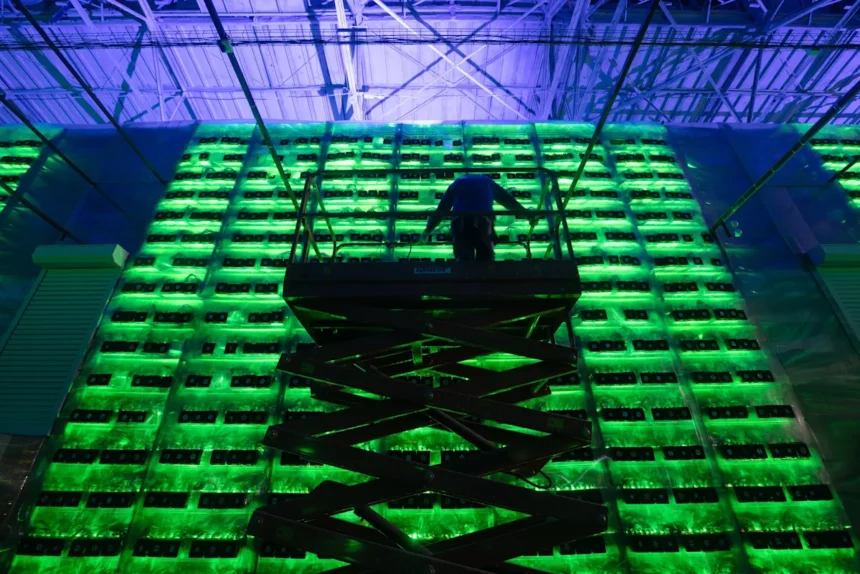
Shares of companies involved in large-scale computing for Bitcoin have recently outshone the cryptocurrency itself, driven by a shift towards hybrid models that integrate artificial intelligence (AI) and high-performance computing (HPC). Traditionally referred to as “miners” due to their involvement in the Bitcoin creation process—akin to mining for gold—these firms have experienced turbulent share price fluctuations in tandem with the cryptocurrency’s price volatility.
In recent years, the mining sector initially surged during the advent of the AI boom but subsequently faced a downturn as mining profitability dropped and competition intensified. Despite experiencing significant turmoil in the crypto market recently, Bitcoin has seen a 14% increase in 2025, nearing its all-time high of almost $126,000 achieved earlier this month. Investor interest in Bitcoin has surged following a pro-crypto stance during the second Trump administration, however, it is the miners who are reaping the most substantial rewards this year.
A fund tracking publicly listed mining companies has reportedly skyrocketed more than 150% year-to-date, with a notable shift in how these companies are perceived by investors. Unlike previous cycles in which miner stocks primarily rose in correlation with Bitcoin’s increase, these companies are now increasingly recognized for their potential as tech infrastructure firms.
According to John Todaro, an analyst at Needham & Co., discussions surrounding miners have largely pivoted away from Bitcoin and mining itself, with investors focusing predominantly on AI and HPC opportunities. Notable entities such as Cipher Mining Inc. and IREN Ltd. illustrate this transition well, with their shares climbing approximately 300% and 500% respectively this year as they embrace AI infrastructure.
Earlier in 2025, Cipher Mining inked a significant 10-year, roughly $3 billion colocation deal with Fluidstack—which has backing from Google—guaranteeing $1.4 billion in lease obligations in exchange for a 5.4% equity stake. This arrangement underscores the increasingly blurred lines between crypto mining and AI computing. Concurrently, IREN successfully completed a $1 billion convertible notes offering, while TeraWulf Inc. declared intentions to issue $3.2 billion in senior secured notes aimed at expanding its Lake Mariner data center located in Barker, New York.
Bitdeer Technologies Group, based in Singapore, also rallied close to 30% recently after announcing initiatives to repurpose key mining sites into AI data centers, including a 570-megawatt facility in Clarington, Ohio. The company forecasts that a full conversion could yield annual revenue exceeding $2 billion by 2026. Jeff LaBerge, Vice President of Capital Markets and Strategy at Bitdeer, emphasized that AI and HPC efforts are designed to complement existing mining operations rather than replace them.
This strategic shift toward AI is a direct response to last year’s Bitcoin halving event, which reduced miner rewards from 6.25 to 3.125 Bitcoin. In the aftermath, rising difficulty levels and diminishing transaction volumes have significantly compressed profit margins for miners. Even the recent price surges in Bitcoin have offered little relief to miners facing unfavorable unit economics.
The transition towards AI-HPC by these firms signifies a slowdown or halt in expanding the Bitcoin hashrate—an indicator of the overall mining capacity—as a portion of their power resources gets redirected. Analysts like Wolfie Zhao from TheMinerMag have noted that companies such as Riot Platforms Inc., IREN, and Bitfarms have indicated they will refrain from increasing their hashrate in the near future. The emphasis has shifted from merely adding more hashrate to utilizing energy resources more efficiently.
With Bitcoin’s hashprice hitting unprecedented lows, this transformation appears inevitable, signaling a new era where mining and computing share an overlapping energy framework. Todaro also shared insights regarding the financials, pointing out that revenue per megawatt and earnings before interest, taxes, depreciation, and amortization (EBITDA) margins are considerably superior for HPC and AI colocation than for traditional mining. In light of Bitcoin’s volatility and the risks tied to halving events, capital markets are increasingly favoring AI-focused data centers, offering significantly higher valuations than traditional mining operations.