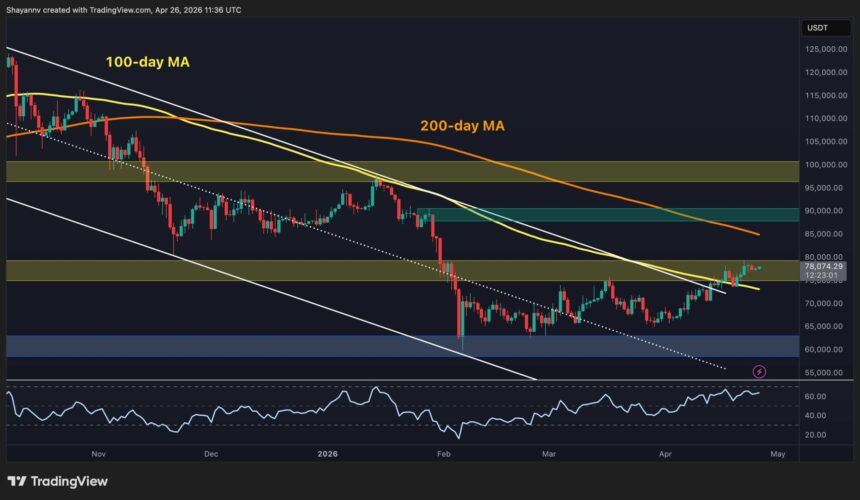
Bitcoin’s price has seen a steady rise, currently trading at $78,000 as April concludes. This upward movement has taken the cryptocurrency above the midpoint of the $75,000–$80,000 resistance band. Unlike previous volatile surges, this ascent has been more measured and orderly, suggesting a potential buildup for a significant breakout ahead.
On the daily chart, Bitcoin’s structure appears increasingly robust. The asset has maintained a position above what was once a descending channel and has reclaimed the 100-day moving average. Additionally, the Relative Strength Index (RSI) is trending upwards towards the high 60s, indicating that momentum is building rather than waning. The $75,000–$80,000 resistance zone is being methodically reclaimed, with the psychological benchmark of $80,000 serving as the next pivotal test. Beyond this, the region around $85,000 and the 200-day moving average at approximately $85,000 represent key supply points that could become primary targets for Bitcoin’s price movements.
A noteworthy pattern is emerging from recent price behavior: each dip in the past three weeks has found support at progressively higher levels, reflecting a classic demand signal rather than an indication of weakness. The $74,000–$75,000 area, along with the 100-day moving average, has become crucial support levels. A closure below these metrics would serve as an early warning signal that the recent breakout might be losing momentum.
Analyzing the 4-hour chart reveals a two-layered structure reinforcing this recovery. An overall ascending channel from the lows in February encapsulates the broader trend, while a sharper trendline from early April has propelled prices from around $68,000 to current levels near $78,000 over the span of three weeks. Currently, Bitcoin is navigating the upper half of the broader channel, with support from the steeper trendline near $77,000. The RSI is hovering close to 60, indicating elevated levels but not yet signaling overbought conditions. The region around $79,000–$80,000 serves as both an upper boundary of the channel and a key resistance point.
In terms of market sentiment, a paradox arises from the funding rate data. Despite Bitcoin’s ascent to $78,000—the highest level since February—funding rates across multiple exchanges remain negative, currently at around -0.014. The dominance of short positions dating back to February persists, shading the current rally. Traders are still compensating for holding short positions even with prices up over 20% from previous lows.
Rather than a cautionary indicator, this creates a structural advantage for buyers. Price increases occurring despite negative funding suggest that the rally is met with resistance from derivatives traders. Each short position established against this upward trend represents a future opportunity for forced buying if prices continue to rise. Should Bitcoin trigger a wave of short liquidations at $78,000, the negative funding context could enhance the buying pressure, potentially driving prices significantly higher than organic demand might suggest.
With the backdrop of structural advantages in the derivatives market, the potential for a sharper move toward the $85,000–$90,000 region looms on the horizon, creating an intriguing scenario for traders and investors alike.