Bitcoin has faced significant challenges in maintaining its value amid a year marked by surging stock market gains, prompting concerns that another major price crash might be on the horizon. The cryptocurrency’s price saw a staggering 30% decline over the past 12 months, leading to high-profile figures like billionaire Mark Cuban re-evaluating their positions on bitcoin and cryptocurrencies.
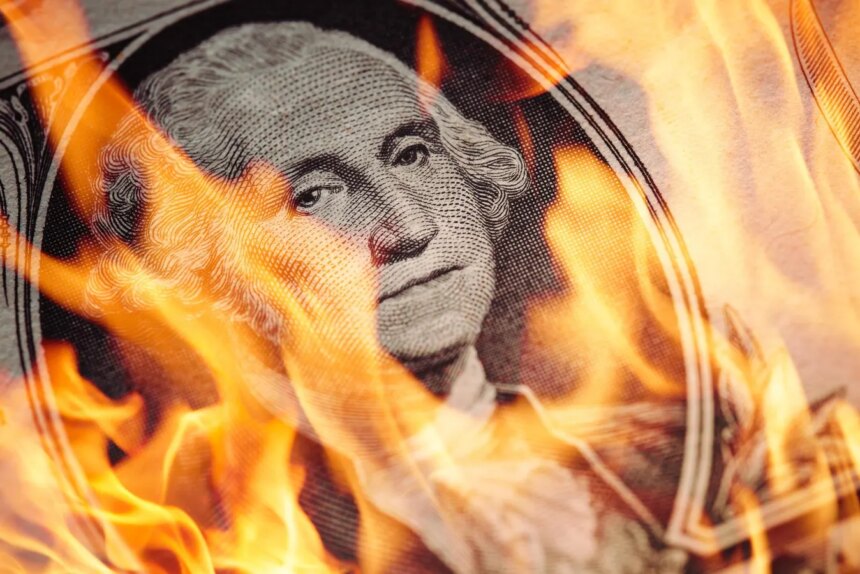
Recently, as reports emerge of a transformative development from the White House regarding bitcoin, a prominent bitcoin advocate, Anthony Pompliano, has suggested that the ongoing devaluation of the U.S. dollar could trigger a substantial price rally for bitcoin—potentially reaching $1 million. Pompliano, the CEO of bitcoin treasury company ProCap Financial, expressed on CNBC his belief that U.S. government spending and money printing will not abate. “That means that bitcoin will be back … bitcoin has no top because the dollar has no bottom,” he stated.
Despite efforts by the Trump administration to curb spending, the U.S. government has continued to expand its fiscal footprint, partly due to measures instituted during the COVID-19 pandemic. The Federal Reserve’s balance sheet has ballooned to approximately $6.3 trillion, with the M2 money supply hitting an all-time high of nearly $22.7 trillion, driven largely by government deficit spending and banking dynamics.
U.S. national debt has surged in recent years, exacerbated by extensive spending during the pandemic. In response to rising inflation, interest rates have been increased, further complicating the management of the U.S.’s nearly $40 trillion debt. Against this backdrop, the price of gold has doubled in the past two years, a trend attributed to traders anticipating that ongoing inflation and Federal Reserve policies will undermine the dollar’s value.
Pompliano has pointed out that, due to continued monetary expansion, non-productive assets such as bitcoin and gold are outperforming traditional equities. He acknowledged that while bitcoin could eventually reach the $1 million mark, determining the timeline for such a rise remains speculative.
Concerns about the stability of the U.S. dollar have become more pronounced. Industry veteran Ray Dalio has warned about the potential for a looming financial crisis and expressed skepticism about the effectiveness of fiat currencies as stores of wealth in such an event. His perspective aligns with recent analysis from JPMorgan, which indicates a potential shift in investment strategies as the so-called “debasement trade” transitions from gold to bitcoin. JPMorgan analysts have observed that inflows into bitcoin exchange-traded funds (ETFs) are outpacing those for gold ETFs, suggesting a growing confidence in bitcoin’s durability as an asset.
As the cryptocurrency market continues to navigate these turbulent economic waters, the interplay between regulatory developments, investment sentiments, and the fundamental value of bitcoin remains under close scrutiny. The upcoming changes signaled from the White House could further impact the landscape, raising the stakes for investors in both bitcoin and traditional financial markets.