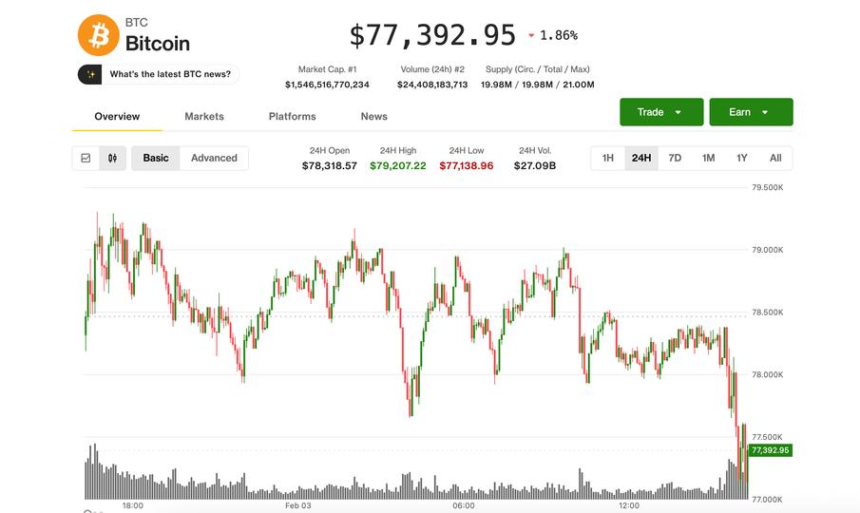
Bitcoin has experienced fluctuations in the market after recovering roughly 7% from its weekend lows, briefly surpassing the $79,000 mark. Currently, bitcoin is trading at approximately $77,100, reflecting a 2% decline over the past 24 hours. Meanwhile, Ethereum is faring even worse, dipping to $2,260, which represents a 4.7% drop.
This latest round of selling comes amid strong gains for gold and silver, which appear to be rebounding from their own tumultuous price movements last Friday. Concurrently, U.S. stocks are witnessing a downturn, particularly among a group of AI-related companies. Major players such as Nvidia, Oracle, Broadcom, Micron, and Microsoft are down between 3% and 5%, contributing to a 1% drop in the Nasdaq index.
In the cryptocurrency sector, the largest publicly traded bitcoin holder, MicroStrategy, has seen its shares decline by more than 2%, hitting fresh lows. Coinbase and Bullish are also experiencing similar downward trends. Galaxy Digital shares have plummeted over 12% following disappointing fourth-quarter results, while stablecoin issuer Circle has reported a 3.5% decrease.
Conversely, some bitcoin mining companies that have pivoted to providing AI infrastructure are showing gains. TeraWulf has risen by 12% after acquiring two industrial sites in the U.S., which could potentially double its power capacity to 2.8 gigawatts. Cipher Mining has seen its shares increase by 4% due to plans to raise $2 billion in the junk bond market aimed at funding its Black Pearl data center in Texas, which will provide 300 megawatts of capacity under a long-term lease with Amazon Web Services.
Market analyst Jake Ostrovskis, head of OTC at the crypto trading firm Wintermute, has pointed out that options flows indicate traders are preparing for a temporary bounce from the weekend lows below the $75,000 threshold. He notes that the current lack of demand for upward exposure is reminiscent of market conditions from April 2025. Heavy demand for short-term downside protection has caused a distortion in the options market, leading to a situation known as backwardation, where short-dated volatility exceeds that of longer-dated contracts.
Ostrovskis is closely monitoring for signs of a normalization in the options curve back into contango, which may signal a more stable market. He indicated that he would feel more confident about identifying local lows once this volatility cools down.