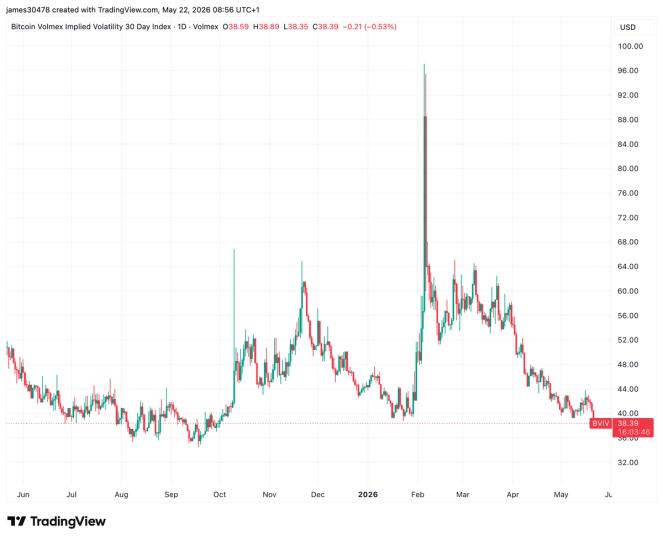
Financial headlines have been filled with warnings about macroeconomic risks, yet the current volatility index for Bitcoin suggests that traders may be growing increasingly complacent. Bitcoin is presently trading at approximately $77,341.59, and its annualized 30-day implied volatility index, known as the BVIV, has dipped to 38%. This marks the lowest level recorded since October 2025, according to data from Volmex. A decline in implied volatility typically indicates that traders are anticipating calmer price movements and fewer significant fluctuations in the cryptocurrency’s value.
Shiliang Tang, Managing Partner at Monarq Asset Management, commented on this trend, stating that the collapse in Bitcoin’s volatility is evident in the BVIV metrics, which are closely monitored to gauge market sentiment. He pointed out two main factors contributing to this trend. First, the geopolitical tensions arising from conflicts, particularly in Iran, seem to be subduing as the situation progresses. Second, institutional buying—specifically by Strategy (MSTR) and its associated financial instruments—is acting as a stabilizing force in the market, providing a structural floor for Bitcoin and thereby dampening its downside volatility.
Tang also highlighted the role of systematic “call overwriters” in reducing volatility levels. These institutional funds employ strategies that involve selling higher strike out-of-the-money call options to generate additional income on their existing Bitcoin holdings. With Bitcoin trading around $77,300, individuals and institutions engaging in this strategy are selling options at prices above the current trading value, effectively suppressing implied volatility and lowering expectations for drastic price movements.
He further explained that the consistent sale of Bitcoin options by these sophisticated funds serves to collect premium income, leading to a steady supply of options that keeps the implied volatility in check. Because Bitcoin has lagged behind other risk assets in terms of upward momentum, these systematic overwriters are capitalizing on the opportunity to aggressively sell options for yield, which continues to exert downward pressure on overall volatility.
Current market conditions also show Bitcoin trading just below $77,000, while oil prices, commonly viewed as indicative of geopolitical risk, remain stable with WTI crude futures priced below $100 per barrel. In a notable shift, Strategy has acquired an impressive 171,238 BTC in 2026, surpassing the approximately 63,450 BTC produced via mining during the same timeframe. This discrepancy emphasizes sustained institutional appetite for Bitcoin and effectively reduces available supply in the market.
Furthermore, Bitcoin’s dwindling volatility can be seen as a sign of its maturation as an institutional asset. As the cryptocurrency ecosystem expands with increased adoption among exchange-traded funds (ETFs), institutional asset managers, corporations, and treasury allocators, market liquidity has deepened. A more diversified ownership base among Bitcoin holders naturally contributes to a decrease in the extreme volatility that characterized Bitcoin during its early years.