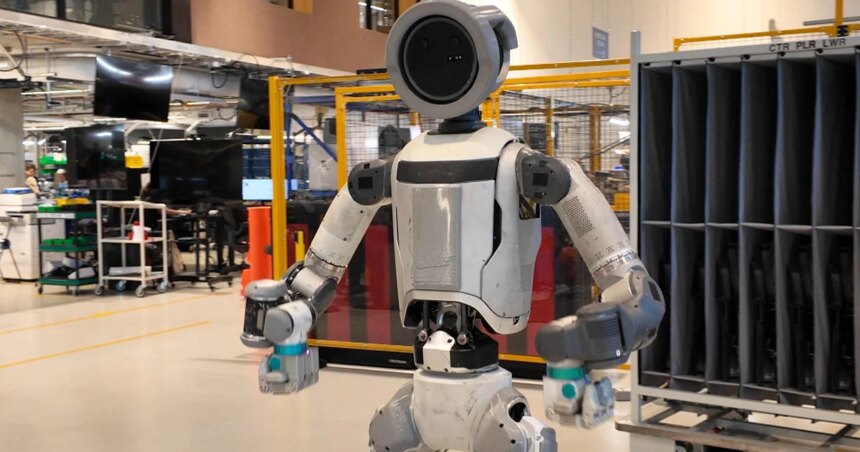
In a recent segment on 60 Minutes, the advancements in Boston Dynamics’ humanoid robot, Atlas, were showcased, highlighting a remarkable evolution from its earlier designs. Initially presented in 2021, the earlier Atlas model was known for its bulky form and limited movement, capable only of running, jumping, and maintaining balance when pushed. However, the latest iteration of Atlas exhibits an extraordinary range of motion, performing feats such as cartwheeling and dancing with exceptional fluidity. It can also rotate its upper body 180 degrees without changing its position, embodying a level of agility far beyond human capabilities.
Boston Dynamics CEO Robert Playter discussed the company’s philosophy regarding robot design, emphasizing the importance of pushing beyond human limitations. “We think that’s the way you should build robots,” he explained, illustrating Atlas’s ability to pivot at the core rather than physically turning around like a human. This design choice aligns with the company’s innovative vision.
Scott Kuindersma, head of robotics research at Boston Dynamics, elaborated on the technological advancements underpinning Atlas. One significant improvement is the absence of wires crossing the joints of its limbs, torso, and head, which enhances its range of motion and simplifies maintenance. This design alleviates the common reliability issues seen with traditional robots, where wires can break over time.
Atlas is further enhanced by its AI brain, powered by Nvidia chips, allowing it to learn various tasks through teleoperation. During a demonstration, a Boston Dynamics scientist utilized virtual reality equipment to train Atlas in specific tasks, such as stacking cups and tying knots. Kuindersma acknowledged the complexity of engineering robotic hands, remarking on human hands’ versatility in performing numerous manipulation tasks. While Atlas features three digits on each hand capable of transitioning between functions—acting like a thumb or grasping objects—the design is still a work in progress.
In terms of sensory feedback, Atlas is equipped with tactile sensors on its fingers, feeding information to its neural network to improve its object manipulation capabilities. Despite the advancements, Kuindersma noted ongoing challenges in teleoperation systems, specifically the need for better control over the shape, motion, and force of the robot’s grasp.
Amid the excitement surrounding humanoid robotics, Whitaker pointed out the prevailing hype and optimism about the future of these technologies. While financial institutions predict a future with millions or even billions of robots integrated into daily life, the reality remains that these innovations are still in development. Playter acknowledged this gap, pointing out the hype cycle surrounding humanoid robots while emphasizing the need for reliability and affordability before widespread deployment can occur.
As exciting as these advancements may be, building dependable robots remains a complex and time-consuming process, requiring a careful balance between innovation and practical application.