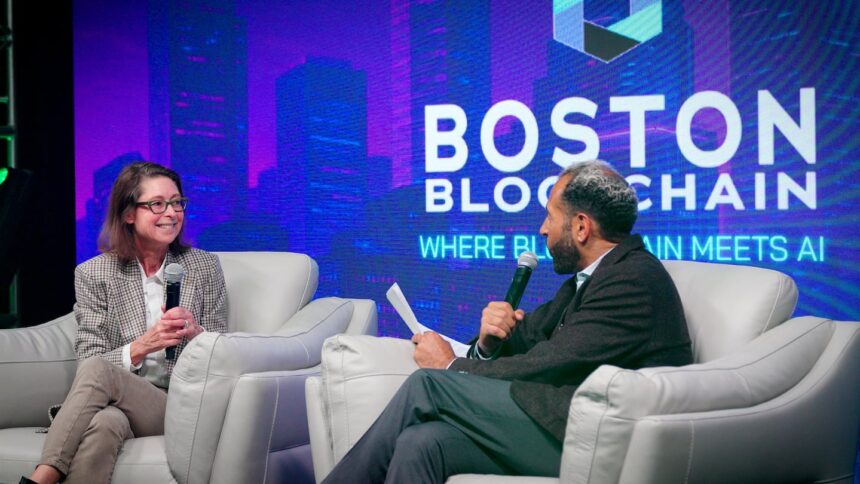
During the recent Boston Blockchain Week conference held in Quincy Center, the question arose: Can Greater Boston transform into a hub for blockchain and cryptocurrency businesses? Fidelity Investments CEO Abby Johnson expressed optimism about this prospect during a discussion with Ian Cain, co-founder of Qubic Labs.
As major financial institutions like Fidelity and State Street increasingly integrate digital assets into their operations, Boston finds itself at a unique crossroads. While Fidelity has been a pioneer in the crypto space, the region lacks a prominent, globally recognized blockchain or crypto business following the move of Circle, known for its digital currency, to New York. Nevertheless, organizations like Qubic Labs are hopeful for the future, citing the city’s wealth of tech talent, financial expertise, and a robust network of universities as key advantages. Founded during the COVID-19 pandemic, Qubic Labs aims to promote Quincy and its surroundings as a leader in the global blockchain ecosystem.
The conference last week drew approximately 500 attendees, demonstrating a lively interest in the topic. Quincy Mayor Tom Koch even highlighted the city’s history as the first to sell a municipal bond on blockchain back in 2024, specifically mentioning a $10 million issuance facilitated by JPMorgan Chase. Blockchains, characterized as distributed databases shared across multiple computers, not only facilitate cryptocurrency transactions but also support traditional business dealings.
Johnson, representing one of the world’s largest financial companies, added significant clout to the event. She reflected on Fidelity’s journey with digital assets, recalling its initial experiments over a decade ago. Johnson emphasized the company’s commitment to shaping favorable regulatory environments for blockchain technology and cryptocurrencies, noting recent innovations such as a product that enables investors to trade and hold cryptocurrencies in tax-advantaged IRAs and a tokenized money market fund launched on the Ethereum blockchain.
“I would love to see Boston as a hub for all this activity,” stated Johnson. She pointed out that the city’s environment, which is home to numerous companies in similar fields, helped Fidelity thrive in its core mutual fund business. Highlighting the dual nature of competition, she noted, “Sometimes people say, ‘Well, someone can quit and walk down the street and get the same job [with a competitor].’ That’s true and that is a negative or a risk. But the upside of being a talent destination in an exciting and growing area makes it all worth it.”
As the Boston area continues to explore its potential in the blockchain and crypto landscape, the dialogues and initiatives emerging from conferences like this could play a pivotal role in shaping the region’s future in the digital assets space.