A recent analysis from Ritholtz Wealth Management highlights Caterpillar, Inc. (CAT) as a standout performer in the current stock market landscape. The firm’s Josh Brown emphasized the simplicity of identifying opportunities through line charts that exhibit breakout patterns, particularly in light of Caterpillar’s recent surge after a lengthy period of stagnation.
After years of minimal movement, CAT’s breakout last July coincided with growing enthusiasm in its power sector, which has been bolstered by the rising AI market. Since this breakout, the stock has continued to climb without dipping below its rising 200-day moving average, marking it as a strong investment choice for many.
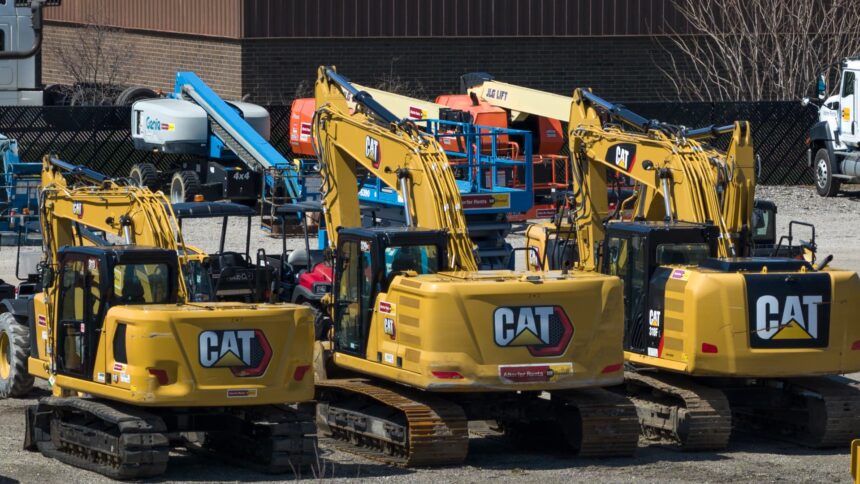
Sean Russo from the same firm noted that Caterpillar’s recognizable yellow machinery has become an iconic presence on construction sites across the nation. The brand’s visibility and market positioning is comparable to that of Deere, another heavy machinery manufacturer, which has also seen positive returns. However, CAT’s shares have outperformed, rising 120% since June 2025, while Deere has seen a more modest return of 13%.
The broader industrial machinery sector has been experiencing significant growth, with 28 out of 34 machinery stocks within the Russell 1000 showing positive returns. The median return for these stocks is an impressive 14%, compared to a much-lower 2% for the median S&P 500 stock. Leading this momentum, CAT has risen by 33%, while Deere follows with a total return of 23%.
Interestingly, while construction has historically been a key driver for Caterpillar, the company’s Power & Energy segment is now the largest and fastest-growing part of its business. This segment encompasses vital industrial applications in oil and gas, energy generation, and rail markets, including advanced technologies for engine-powered assets. In 2025, CAT’s Power & Energy division reported total sales of $32.2 billion—an increase of 12%—with profitability also up by 12%, reflecting strong margins of 20%. Particularly notable was the power generation segment, which experienced a 32% surge to $10.3 billion, largely fueled by growth in data center applications.
Looking ahead, CAT’s full-year revenue is projected to grow by 5% to 7% year-over-year, with margins expected to remain robust. CEO Joe Creed asserted that demand in the power generation segment will remain solid for the next five-plus years, primarily due to the expanding energy needs from data centers and natural gas applications. Importantly, the company anticipates considerable growth—more than 50%—beyond current levels by 2030.
From a technical analysis perspective, although CAT is currently significantly above its 200-day moving average, trading at approximately $770 compared to the 200-day at $565, analysts caution that potential investors should be wary. The stock has climbed steadily, though not without periodic consolidations that reset momentum. As it currently sits above its 50-day moving average, maintaining this position is crucial for short-term traders. However, for those considering long-term investments, the current valuation appears stretched, prompting a recommendation to wait for a more favorable entry point during a future consolidation period.
Overall, while CAT has shown impressive gains and remains in a strong uptrend, caution is advised for potential investors due to its current status relative to key moving averages.