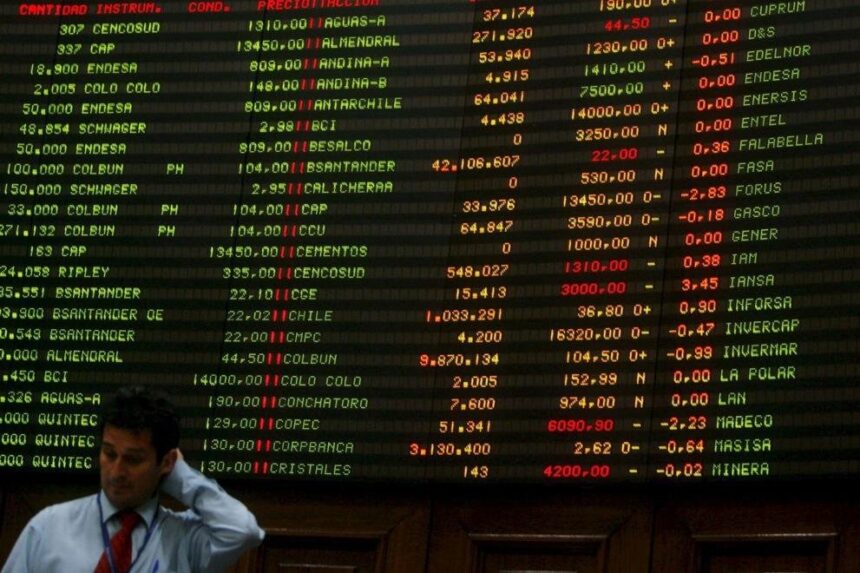
Chile’s stock market has made a remarkable resurgence, achieving its strongest performance in 32 years during 2025. Ranked fourth globally, it posted an impressive return of 56% in Chilean pesos, solidifying its position as the best-performing exchange in Latin America. Ghana’s stock market led the rankings with an exceptional gain of 79%, followed closely by South Korea and Zambia.
The Santiago stock exchange’s main benchmark, the Selective Stock Price Index (IPSA), exceeded historic levels, closing the year at 10,481.47 points. This marked the index’s highest annual performance since 1993, with trading volumes rising dramatically; the value of shares traded surged 67.9% to $50.87 billion.
Out of the 30 companies listed on the IPSA, 28 delivered positive returns in local currency, while all reported gains when converted to U.S. dollars. The standout performer was Sociedad Química y Minera de Chile, a leading nonmetallic mining company renowned for lithium and iodine production, achieving a remarkable return of 74.32%.
Economic analysts attribute this strong performance to a broader normalization of macroeconomic conditions in Chile, with projected growth rates surpassing 2%. Inflation trends have been favorable, prompting cuts in the monetary policy rate, which enhanced the appeal of investment portfolios. The banking sector, in particular, emerged as a vital contributor to the IPSA’s success, with normalized credit risks making it an attractive investment avenue.
Analysts have also pointed to a bullish outlook for commodities, driven by rising copper prices, which are bolstered by anticipated advancements in energy transition initiatives. This systemic demand for electricity has invigorated mining activities and helped maintain high commodity prices.
Political stability has also played a critical role in the market’s resurgence. Ahead of the presidential elections slated for November 2025, there was notable strategic asset allocation, with polls hinting at the likelihood of a pro-market government. This scenario was validated by the December runoff election of right-wing candidate José Antonio Kast, whose economic policies are expected to foster market confidence for the upcoming 2026-2030 period.
The resilience of Chile’s economy has notably surpassed initial GDP growth predictions of around 2%, with estimates now adjusted to between 2.3% and 2.4%. This upward adjustment has largely been attributed to a recovery in investment during the latter half of the fiscal year. Additionally, the implementation of a tax reform aimed at bolstering savings in the private pension sector, along with a rise in business confidence, has contributed to enhanced corporate profitability.
These developments have collectively fostered a positive outlook for the market, suggesting a constructive trajectory for the next four years under the governance of Kast. Analysts have expressed optimism regarding capital flows, citing decreased country risk and increased financial stability, signs that are likely to promote stronger investment in the near future.
These contributing factors culminated in what many are calling an exceptionally strong year for the IPSA, setting a solid foundation for continued market growth in the years to come.