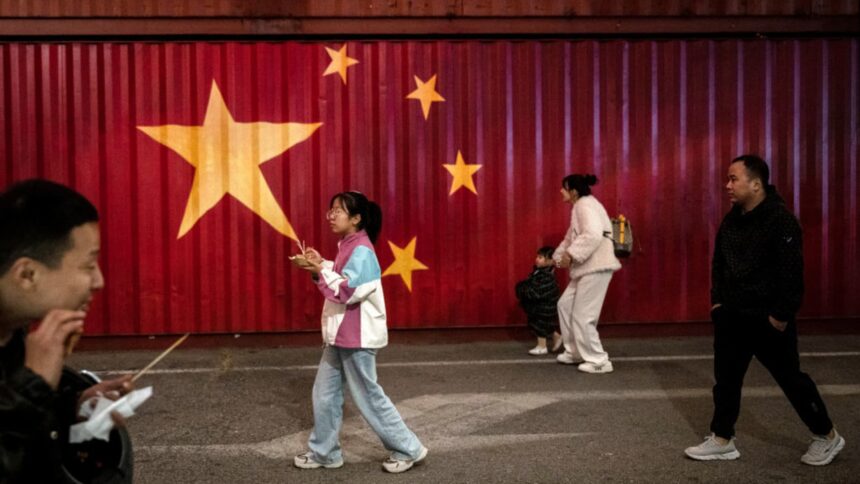
During the Golden Week holiday in Beijing, visitors admired a large Chinese national flag displayed prominently at an outdoor market, a symbol of national pride amid significant shifts in the country’s investment landscape. China has recently implemented new regulatory measures aimed at restricting retail investors’ access to U.S. stocks, marking a shift that favors domestic capital flows toward Hong Kong.
The Chinese securities regulator has heightened scrutiny on offshore brokerages, pinpointing companies like Tiger Brokers, Futu Holdings, and Longbridge Securities as targets for an intensified crackdown on what it calls illegal cross-border securities operations. This initiative is part of a long-term strategy to close loopholes that previously enabled mainland investors to engage with overseas markets without adhering to formal channels.
Vey-Sern Ling, a senior equity advisor at Union Bancaire Privée, noted that these recent actions could reduce the availability of funds for American Depository Receipts (ADRs) listed in the U.S. Consequently, Hong Kong listings may gain increased allure, especially for companies eligible to be part of the Stock Connect program, which facilitates investments in select Hong Kong stocks through local brokerages in mainland China.
These measures emerge alongside Beijing’s ongoing effort to clean up its financial sector under the oversight of securities regulator Wu Qing, with added vigilance over cross-border capital movement and associated financial risks. Despite concerns regarding the implications for foreign access to Chinese markets, analysts largely maintain that the impact on global investors will be minimal.
Theodore Shou, chief investment officer at Skybound Capital, asserted that the crackdown is unlikely to significantly disrupt trading volumes in Chinese ADRs. He emphasized that the mainland investors affected represent only a small fraction of the client base for many of these platforms, who could continue to find alternative avenues to overseas markets.
Instead, the focus may shift toward the migration of Chinese listings and investor activity to Hong Kong, a move analysts suggest Beijing views as a more secure and manageable offshore financial hub. Ling further cautioned that the potential boost from this shift might be constrained, as many major Chinese firms have already transitioned toward Hong Kong listings over recent years amid increasing tensions between the U.S. and China.
Among companies that have dual listings in the U.S. and Hong Kong, trading typically leans heavily toward Hong Kong in most instances, according to Ling. Some market strategists argue that these regulatory tightening measures also align with China’s broader aim to direct investor interest towards its domestic technology leaders and key strategic industries.
In light of this trend, a series of significant initial public offerings are anticipated in the coming months, particularly for companies like memory chipmaker CXMT, robotics firm Unitree, and semiconductor producer YMTC. Peter Alexander, founder of the Shanghai-based consulting firm Z-Ben Advisors, emphasized that the public launch of these firms transcends mere financial metrics, highlighting China’s commitment to advancing its technological capabilities and addressing the gaps that exist with competitors like the United States.