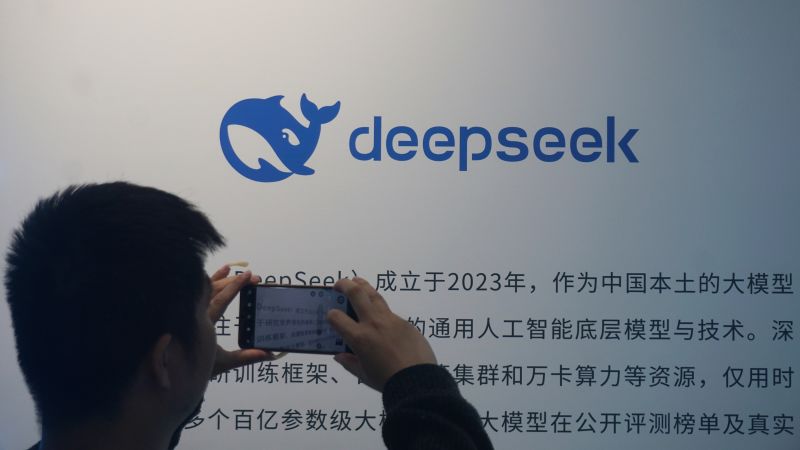
Hong Kong — China’s DeepSeek has unveiled a preview version of its new model, V4, signaling its ambition to compete with notable players like OpenAI, Anthropic, and Google. This announcement comes just a year after the startup made headlines with its groundbreaking R1 model, which established DeepSeek as a significant contender in the global AI industry.
The Hangzhou-based company emphasized substantial advancements in V4’s reasoning and autonomous capabilities, which can handle tasks such as code writing. The new model is designed to process a larger volume of tokens—essential units of information crucial for AI comprehension—brandishing a promise of enhanced efficiency.
DeepSeek’s initial success with the R1 model disrupted American AI stocks and shifted perceptions toward greater investment in data center infrastructures. It also heightened the competition between Chinese and US tech sectors. However, analysts predict that the market response to V4 may not mirror the dramatic impacts caused by R1. Ivan Su, a senior equity analyst at MorningStar, explained that while R1’s launch was unexpected, V4’s evolution is a continuation of a trend that is already accounted for in stock evaluations.
The open-source nature of V4 allows broader access compared to many proprietary American models, thus fostering quicker adoption across various sectors, from e-commerce to robotics. DeepSeek’s strategy exemplifies China’s approach to competing globally, overcoming limitations regarding access to advanced technology and tools, particularly amid Washington’s stringent export controls.
In adapting to these challenges, DeepSeek has collaborated with Huawei to leverage domestic chip technology. The AI startup confirmed that V4 runs on Huawei’s “Ascend 950” chips, combined with technology from Cambricon, another local chipmaker. This move contrasts with the R1 model, which relied on Nvidia hardware. Wei Sun, principal analyst at Counterpoint Research, noted that using domestic chips could make V4 even more impactful than R1, facilitating rapid domestic adoption and contributing to accelerated global AI advancements.
While industry leaders such as Anthropic’s Claude, OpenAI’s ChatGPT, and Google’s Gemini currently dominate the AI landscape, Chinese companies are making significant strides in open-source models. DeepSeek claims V4 boasts the best coding capabilities and world-class reasoning among its counterparts, although it acknowledges that it still falls short of leading models like Gemini in overall performance.
Despite its rise, DeepSeek’s journey has not been without controversy. The company has faced allegations from industry giants like Anthropic and OpenAI, which assert that DeepSeek has illicitly drawn from their models. Recently, Michael Kratsios, director of the White House Office of Science and Technology Policy, noted concerns about foreign entities in China engaging in industrial-scale efforts to extract capabilities from US AI innovations. While Kratsios did not explicitly name DeepSeek, his remarks reflect the continuing tensions between the two superpowers. DeepSeek’s response to these allegations has not yet been disclosed.