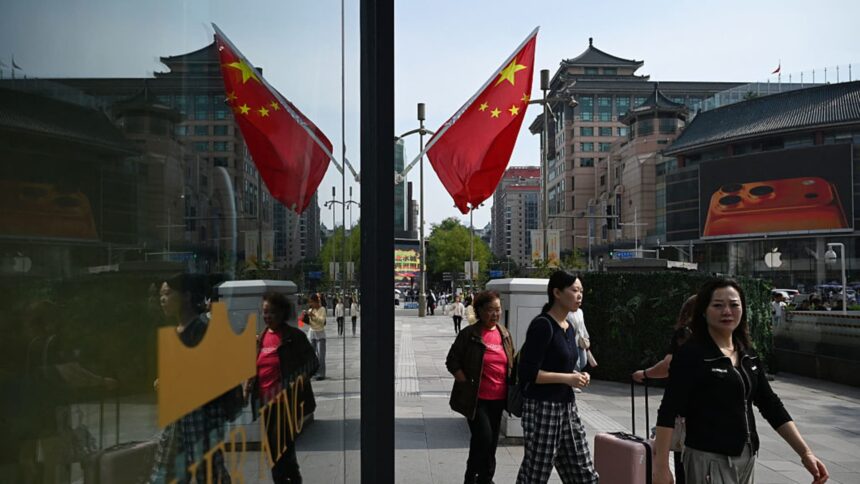
People were seen bustling outside a shopping mall during the week-long National Day holiday in Beijing on October 7, 2025, amid a complex backdrop of economic developments in China. The country’s economy showed signs of acceleration in the first quarter of 2025, primarily driven by robust export growth that offset a persistent weakness in domestic demand. According to data released by the National Statistics Bureau, China’s gross domestic product (GDP) expanded by 5% in the first quarter, up from a previous 4.5% growth rate and surpassing economists’ expectations which had forecasted a 4.8% increase.
The government had set a modest growth target for the year, aiming for a range of 4.5% to 5%, marking the least ambitious goal since the early 1990s. This adjustment reflects a recognition of slowing demand and ongoing trade tensions with the United States. The statistics bureau issued a cautionary statement, highlighting the increasingly complex and volatile external environment, which poses a threat to both national growth and global economic stability. They warned of an “acute” imbalance characterized by “strong supply and weak demand.”
Investment across urban fixed assets, which encompasses real estate and infrastructure projects, saw a year-on-year increase of only 1.7% in the first quarter, falling short of the anticipated 1.9% growth. Notably, the property sector experienced a significant decline, with investments plummeting by 11.2%.
Retail sales indicated a slowing trend as well, rising by only 1.7% in March compared to the previous year, a decline from the holiday-boosted 2.8% increase in February and below the economists’ forecast of 2.3%. Meanwhile, industrial output demonstrated a more promising growth of 5.7% in March from a year earlier, exceeding predictions for a 5.5% increase, although this was a deceleration from the 6.3% growth recorded in February. For the first quarter overall, industrial production surged by 6.1% year on year, underscoring the manufacturing sector’s ongoing dominance as the principal driver of China’s economic growth even as consumer spending remains subdued.
The strong start to 2026 has led some analysts to suggest that there may not be an immediate need for further fiscal stimulus or monetary easing from policymakers. Instead, focus appears to be shifting towards nurturing private consumption and investment. Tianchen Xu, a senior economist at the Economist Intelligence Unit, commented that growth is disproportionately reliant on exports.
In fact, while China’s exports grew impressively by 14.7% in dollar terms during the first quarter, this growth has hits a stall due to geopolitical tensions, particularly the conflict in the Middle East. This conflict has implications for energy logistics and costs, adding pressure to China’s already export-dependent economy. In March, export growth decelerated sharply to just 2.5%, a dramatic drop from 21.8% recorded earlier in the year.
Additionally, rising factory-gate prices in March marked the first increase in over three years, indicating that increased energy costs are beginning to influence the manufacturing landscape, raising concerns about corporate profit margins. As China’s economy navigates these complexities, the outlook for the remainder of the year remains uncertain.