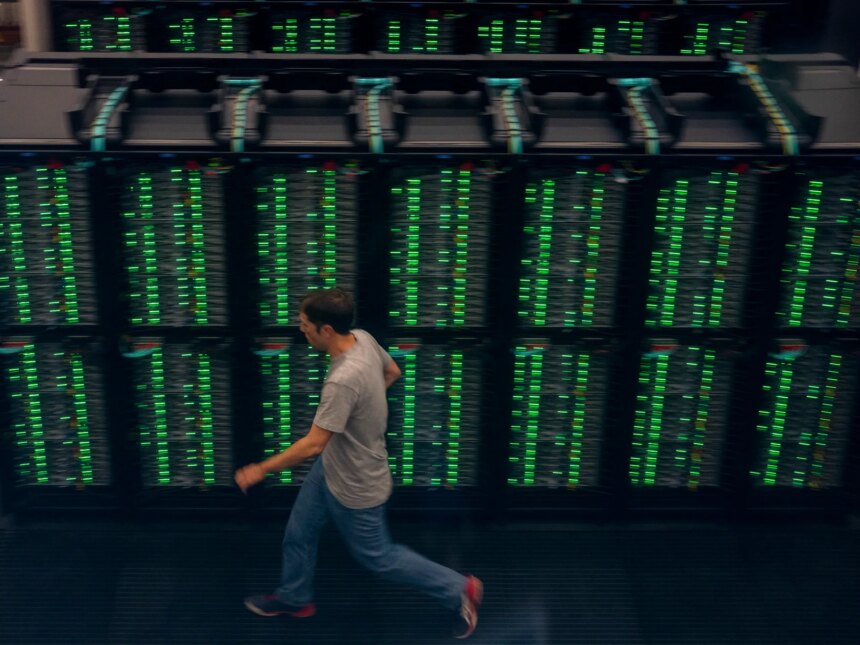
China has achieved a significant milestone by surpassing the United States in an esteemed ranking of the world’s fastest supercomputers, highlighting the nation’s growing prowess in advanced technology. The latest TOP500 list, unveiled in Hamburg, Germany, ranked China’s LineShine as the most powerful supercomputer globally, overtaking the previously leading US-based El Capitan.
LineShine, housed at the National Supercomputing Centre in Shenzhen, demonstrated a remarkable capability, achieving a performance of 2.198 exaflops, which translates to executing over 2 quintillion calculations per second. This places it 20 percent ahead of El Capitan, marking a pivotal moment as it is the first Chinese supercomputer to hold the top spot since Sunway TaihuLight in 2017.
El Capitan, located at Lawrence Livermore National Laboratory in California, had maintained its top performance position since November 2024. Other notable entries in the top five include Frontier from Oak Ridge National Laboratory in Tennessee, and Aurora from Argonne National Laboratory in Illinois. The list also features representatives from countries like the United Kingdom, Japan, South Korea, Italy, the Netherlands, and Switzerland.
Jack Dongarra, an emeritus professor of computer science at the University of Tennessee and a prominent figure in the compilation of the TOP500 list, remarked that LineShine’s performance illustrates China’s growing capabilities despite facing US export restrictions on advanced technology. He noted that while such controls may hinder access to cutting-edge components, they simultaneously spur China to develop domestic alternatives.
LineShine stands out by being the first supercomputer to exceed 2 exaflops solely using general-purpose central processing units (CPUs), distinguishing it from many supercomputers that rely heavily on graphics processing units (GPUs) for tasks related to artificial intelligence. This achievement underscores China’s extensive investment in hardware and software development.
The TOP500 list has been a reference point in the supercomputing field since its inception in 1993, created to track advancements in computational capabilities. Although past lists showed China dominating with nearly half of the top spots in 2019, its representation decreased in subsequent years amid deteriorating relations between Washington and Beijing.
Despite the evolving landscape of supercomputing, experts like Dongarra caution that the ranking represents just one aspect of technological leadership. Other factors, such as scientific performance, energy efficiency, reliability, and the ability to support broad research initiatives, are equally critical.
Addison Snell, co-founder of the computing consultancy Intersect360 Research, emphasized that while it wasn’t surprising to see LineShine’s capabilities, the Chinese developers’ renewed engagement in the ranking is noteworthy. He suggested that this development could catalyze competitive reactions in the US, Europe, and Japan as they strive to establish dominance in AI technology.
The ongoing rivalry between China and the US in leading technological fields has intensified over the last decade, with both nations imposing sanctions and export controls to mitigate each other’s advancements. A recent AI Index Report from Stanford University indicated that China has effectively closed the gap with the US regarding AI model performance.
Although the US continues to lead in the development of top-tier AI models, China is making strides in patent registration and the deployment of industrial robots. Snell argues that while major tech companies like Amazon and Microsoft have the capability to dominate the TOP500 list, the ranking remains vital as an indicator of supercomputing resources geared toward scientific applications.
As the dialogue around supercomputing and AI evolves, experts stress the need for policy that supports initiatives in both fields. The integration of AI in scientific research requires significant investment in supercomputing capabilities, highlighting the intertwined nature of developing leading-edge technology and advancing scientific exploration.