Chinese-made humanoid robots are generating significant interest with their capabilities ranging from performing backflips to making coffee, as developers aim to expand their market presence. Manufacturers in China claim to have received thousands of orders from both governmental and private sectors for humanoid robots designed to carry out tasks like sorting parcels in postal services. This surge in demand comes as the nation grapples with an aging population and increasing labor costs. Nonetheless, some experts highlight a discrepancy between the current demand for humanoid robots and the industry’s capacity to produce them.
Currently, China and the United States are at the forefront of the humanoid robots market, which Morgan Stanley estimates to be worth $5 trillion. While the U.S. leads in developing artificial intelligence with superior high-level computing capabilities, China dominates in mass production, hardware supply, and data collection for training purposes.
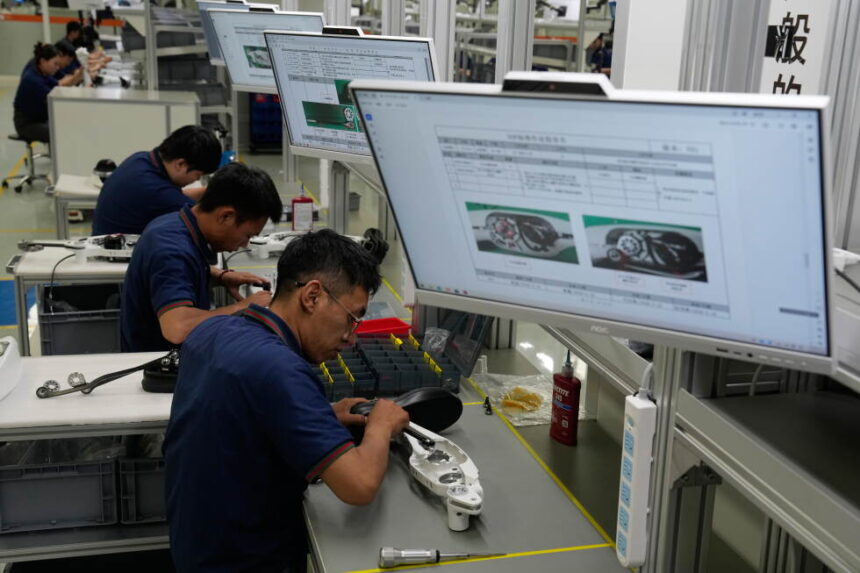
Amid this landscape, Shanghai-based startup Matrix Robotics has emerged as a key player. Their flagship humanoid robot, the “MATRIX-3”, measures nearly 5.6 feet tall and features hands capable of precise movements. Priced at approximately $99,000, it has garnered around 1,000 orders, primarily from coffee chains and hotels, according to CEO Allan Zhang. Despite a current production capacity of only a few hundred units, Matrix plans to ramp up to 5,000 units this year, contingent on order volume.
EngineAI, another startup based in Shenzhen, is marketing humanoid robots suitable for roles such as security guards and museum guides. Their basic model costs around 180,000 yuan ($26,600) and can perform tasks like dancing and boxing. Issac Li, the head of brand and marketing at EngineAI, acknowledges the need to transition these robots into more practical real-world applications.
However, experts caution that most humanoid robots remain more performative than practical. Samm Sacks from the New America think tank points out that these robots currently function poorly in messy or unpredictable environments. Venture capitalist Chibo Tang echoes this sentiment, suggesting that without considerable market demand, many companies are hindered in their mass production efforts. The Ministry of Industry and Information Technology indicates that there are over 140 humanoid robot manufacturers in China, with more than 330 models expected by 2025, although the government has also raised concerns about a potential bubble in the industry.
Research labs and state-owned enterprises have shown interest, helping to generate over 2 billion yuan ($295 million) in orders for applications in industries such as power generation and data centers. Yet, the economics remain challenging; humanoid robots are costly to produce, frail in function, and require structured environments that may not always blend with existing settings.
The real commercial potential may lie more in industrial and logistics contexts, where non-humanoid robots are already fulfilling repetitive tasks. In Japan and the U.S., similar startups are grappling with finding buyers to deploy humanoids in various work environments. Despite these hurdles, the deployment of humanoid robots in China has noticeably accelerated, supported by a population that is accustomed to rapid technological changes.
Experts believe that as technology matures, humanoid robots may be able to undertake heavy lifting and routine jobs in places like warehouses and factories, filling labor shortages in dangerous or redundant roles. This potential extends into the household sector, which could see millions of robots assisting with chores and home tasks.
One user, Yang Ning, recently tested a home cleaning robot that can perform basic organizational tasks but noted its size made it somewhat unwieldy for smaller living spaces.
As of last year, China accounted for approximately 85% of global humanoid robot production. The Chinese government is committed to fostering this industry, providing substantial support in alignment with the Communist Party’s technological advancement plans for 2026-2030. Notable companies like AGIBOT and Unitree are leading the charge, with forecasts predicting that humanoid robot sales could more than double this year.
Despite increasing sales, cost remains a significant barrier to widespread adoption. Manufacturers are optimistic that as production scales, costs will decline. Current estimates suggest that the average price of humanoid robots could drop to about $21,000 by 2050, down from around $46,000 presently.
Challenges persist, including the necessity for better data to train robots for more complex tasks across diverse settings. Experts believe that overcoming these obstacles will take time, with the industry’s mass production capabilities still in their infancy.