On the evening of June 12, a striking incident unfolded on the betting platform Polymarket, where a group of internet gamblers made an unusual prediction regarding international military actions. Thirteen individuals collectively staked $140,000 on the belief that Israel would attack Iran before the week’s end, despite overall odds suggesting such an event was unlikely. Notably, seven of these accounts had only recently been established, while another account had a documented history of profitable bets concerning military actions involving Iran. The audacious gamble proved to be a sound investment, as Israel initiated an attack on the same day, resulting in over $600,000 in profits for the bettors.
This occurrence is part of a broader trend that has raised significant concerns in the political and regulatory arenas surrounding prediction markets like Polymarket. These platforms have witnessed a surge in activity, leading to fears of potential insider trading from military officials with access to confidential information. Recently, a military reservist from Israel was indicted for allegedly using privileged information to place bets on the timing of the strike against Iran, while a U.S. Army Special Forces soldier faced similar accusations related to wagering on the capture of Venezuela’s president, Nicolás Maduro.
An investigation by The New York Times uncovered that over 80 Polymarket users engaged in transactions exhibiting suspicious patterns, including timely wagers that received little public attention. The scrutiny revealed that these bets spanned various topics, including Israel’s military actions and ongoing discussions surrounding cryptocurrency regulation. The Times identified warning signs indicative of insider trading, such as high-stakes long-shot bets by new accounts, and users consistently winning bets tied to a limited number of interrelated issues.
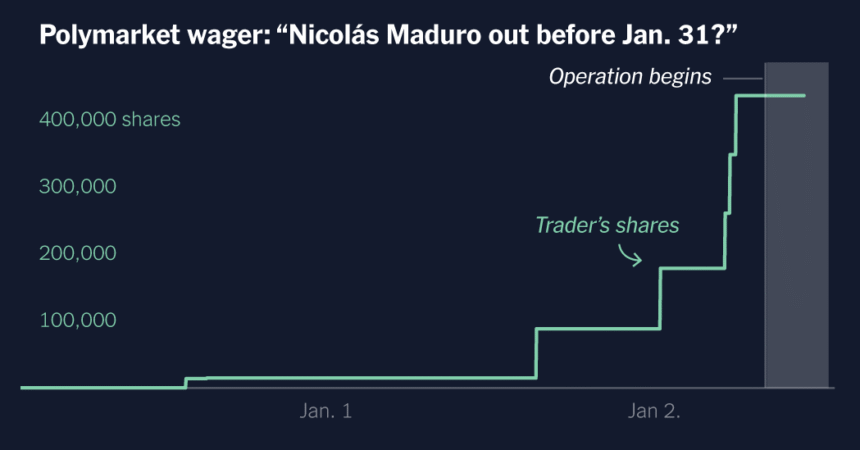
The findings of the report highlighted how these elements indicated potential exploitation of the market by users with access to non-public information. For instance, a user had placed substantial bets on January 1 and 2 regarding Maduro’s potential removal, then pocketed over $400,000 when the Venezuelan leader was arrested the following day. Betting activity surged around significant military and political events, as evidenced by instances where groups of users placed synchronized bets before major announcements.
The ramifications of this trend are significant, especially as lawmakers express growing unease regarding the potential for manipulated markets. Recent actions, such as the passage of a resolution in the Senate restricting the participation of senators and staff in prediction markets, reflect the potential political fallout associated with this betting phenomenon. Moreover, former President Trump’s mixed attitudes towards these platforms illustrate the growing contention surrounding them.
Regulatory bodies, particularly the Commodity Futures Trading Commission (CFTC), are grappling with these rapid developments. History shows that prediction markets have occupied a legal gray area, and recent victories by firms like Kalshi in court have begun to clarify the regulatory framework for such betting activities. Kalshi has recently launched its own investigations into insider trading, reflecting a proactive approach to address the concerns raised by users’ wagering behavior.
Despite Polymarket’s assurances of ongoing monitoring, the company faces scrutiny as it manages a platform that has enabled these suspicious activities. The visibility of trades on platforms like Polymarket has turned the hunt for insider trading into a phenomenon on social media, where users scrutinize betting patterns and publicize their findings.
The explosive growth of these markets poses a conundrum for regulators: how to maintain the integrity of the betting system while also leveraging its potential to provide more accurate forecasting insights. Some supporters of prediction markets believe that certain insider activities can enhance market predictions, advocating for a careful balance between regulation and the capacity for insider knowledge to provide valuable information.
In a time when the intersection of technology, betting, and political events is increasingly scrutinized, the ongoing developments in prediction markets raise essential questions about the integrity of information flow and the ethical boundaries of gambling on global events.