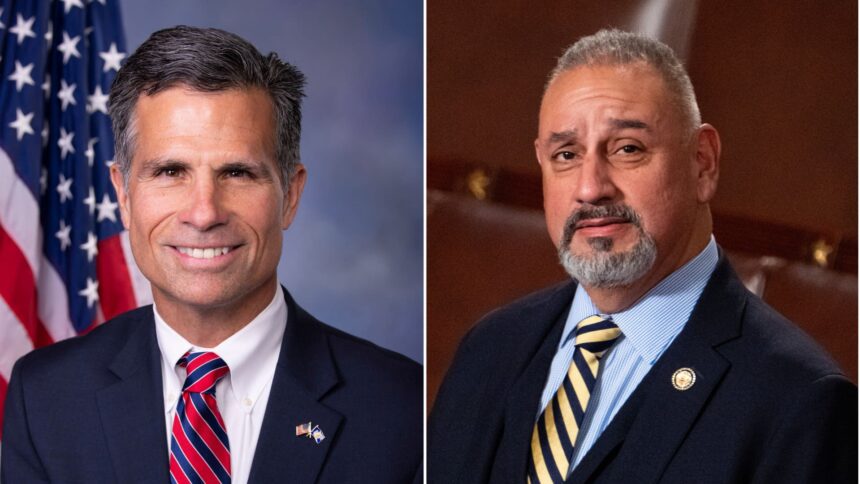
Two members of Congress have made headlines by reporting their purchases of SpaceX stock shortly after the company’s monumental initial public offering (IPO). Representative Dan Meuser, a Republican from Pennsylvania, and Representative Gil Cisneros, a Democrat from California, revealed their investments in recent financial disclosures that are publicly accessible.
Meuser’s financial documentation indicates that a dependent child purchased SpaceX stock valued between $15,001 and $50,000 on June 15, marking the first time in several years that either he or a family member has invested in an individual company’s stock. Meanwhile, Cisneros reported a purchase of SpaceX shares worth between $1,001 and $15,000 on June 18.
SpaceX, the aerospace and satellite company founded by Elon Musk, went public on June 12 with a staggering market capitalization exceeding $2 trillion—making it the largest IPO to date by raising approximately $75 billion.
Cisneros addressed the situation in a statement to CNBC, clarifying that he does not personally manage his family’s investment portfolio, instead relying on outside financial advisors who are tasked with ensuring a diversified investment strategy. He emphasized his adherence to the rules regarding stock trades during his time in Congress and expressed his commitment to advocating for greater ethics oversight for elected and appointed officials concerning their financial dealings.
According to existing regulations, members of Congress and their immediate family members are permitted to trade individual stocks, provided they comply with disclosure requirements and refrain from utilizing nonpublic information obtained through their official roles. Importantly, there is no indication that either Meuser or Cisneros engaged in trades based on confidential information or violated any laws. However, the nature of their committee assignments adds a layer of political sensitivity to these transactions, given Meuser’s role on the House Financial Services Committee and Cisneros’s position on the House Armed Services Committee, which oversees the Defense Department—a significant customer of SpaceX.
Ethics watchdogs have indicated that these disclosures may only represent a small fraction of what might be revealed in the coming weeks, suggesting that more members of Congress from both parties could have participated in trading during SpaceX’s IPO.
Following its IPO, SpaceX shares opened at $150 and quickly drove the company’s market value past the $2 trillion mark, marking a significant moment for both public market demand and the future of artificial intelligence discussions in Washington. As Musk’s ventures continue to gain traction, they are increasingly intertwined with political dynamics and federal contracts, positioning the company and its founder as key players in both the technology and political arenas.
Since the IPO, SpaceX stocks have seen fluctuations, closing at $162 on Thursday—a rise of about 8% from their opening price, though still approximately 20% lower than the closing high of $201.80 reached shortly after going public. Amid this backdrop, previous reports indicated that Representative Lisa McClain, a Republican from Michigan, had family investments benefitting from SpaceX’s debut, with her spouse investing as much as $250,000 in xAI, which Musk has since integrated into SpaceX.
Despite ongoing discussions regarding a potential ban on Congress members trading individual stocks, legislative action has yet to materialize. House Republican leaders have previously pledged to advance such a bill while a similar proposal in the Senate progressed out of committee, yet neither has seen significant movement since its inception. Efforts to reform stock trading practices among Congress members continue to be an area of heated debate.