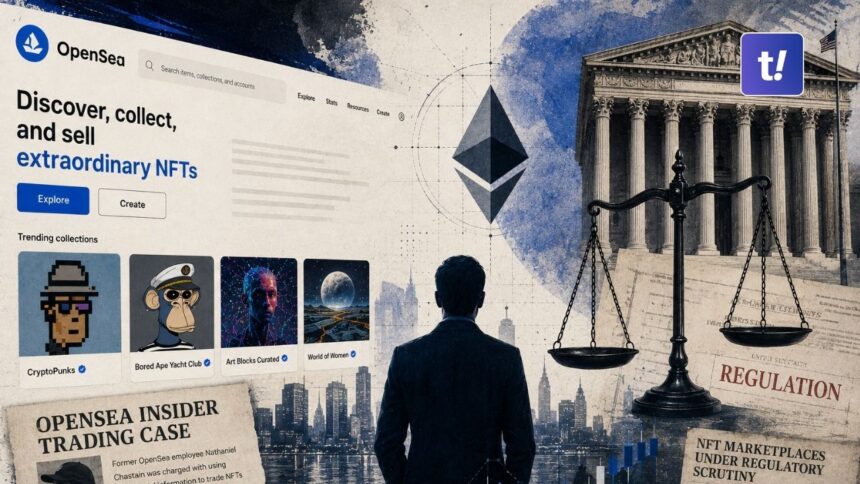
Federal prosecutors made headlines in June 2022 when they charged Nathaniel Chastain, a former employee of OpenSea, with insider trading related to non-fungible tokens (NFTs). This marked a significant moment in the evolving landscape of cryptocurrency and digital assets, as it was labeled the first major prosecution of its kind amid the flourishing Ethereum NFT market, which had transitioned from niche blockchain endeavors to a major player in the crypto economy.
The U.S. Department of Justice accused Chastain of leveraging confidential information regarding which NFT collections would be spotlighted on OpenSea’s homepage. Allegedly, he purchased these NFTs through anonymous wallets before their public feature, subsequently selling them as visibility and trading surged due to their promotion.
During this point in the NFT boom, being featured on OpenSea’s homepage carried substantial market weight, often resulting in immediate increases in asset prices and overall investor engagement. The prosecution of Chastain evolved beyond a specific case into a broader examination of how existing fraud and market abuse laws could be applied to blockchain marketplaces, leading to widespread concern within the crypto sector about the implications for insider trading and regulatory scrutiny.
In May 2023, a federal jury in New York convicted Chastain on charges of wire fraud and money laundering. He faced three months in prison, a $50,000 fine, and was ordered to forfeit Ethereum tied to his trades. His conviction underscored the readiness of enforcement agencies to navigate uncharted legal waters involving digital assets, raising alarms among industry stakeholders.
However, in 2025, the U.S. Court of Appeals for the Second Circuit overturned Chastain’s conviction in a 2-1 ruling. The court criticized the jury instructions from the initial trial and questioned whether the confidential information could qualify as “property” under federal wire fraud laws. This verdict suggested that OpenSea’s data regarding homepage selection may not hold the conventional commercial value linked to property in fraud cases, thereby throwing into question future legal actions based on similar circumstances.
While the ruling did not preclude future prosecutions involving digital marketplaces, it established crucial limitations on applying traditional fraud statutes to blockchain contexts. This outcome emphasized the urgent need for clearer legal frameworks and regulatory guidance, marking a pivotal moment in establishing legal precedents for NFTs.
The implications of the OpenSea case are not confined to NFTs alone; they have sparked a wider dialogue about regulatory scrutiny in the crypto industry. Over the past few years, authorities globally have heightened their focus on disclosures regarding token listings, employee trading behaviors, and allegations of market manipulation affecting various digital assets.
Noteworthy investigations have included instances of individuals profiting from insider knowledge of token listings, like former Coinbase product manager Ishan Wahi, who admitted to criminal activity related to confidential information. As a result, multiple exchanges have faced scrutiny concerning transparency and operational controls.
Simultaneously, regulatory bodies have accelerated the establishment of oversight mechanisms for crypto businesses. Initiatives like the European Union’s Markets in Crypto-Assets framework, and varied licensing structures in Singapore, Hong Kong, and the UAE, reflect a growing movement toward greater regulatory coherence. Meanwhile, in the United States, the ongoing debate among regulators about how to categorize different types of crypto assets has created an ambiguous environment for businesses navigating this landscape.
The OpenSea case stands as one of the earliest significant legal tests for how existing market conduct regulations can apply to blockchain ecosystems. It demonstrates the challenges regulators and judicial bodies face in interpreting trading activities and insider information within these innovative markets.
Industry experts, including Ashish Singhal, Co-founder of CoinSwitch, stress that the implications of the ruling extend beyond NFTs, addressing a fundamental question regulators face: how existing legal frameworks apply to digital ecosystems like NFTs and Web3. While the court’s ruling clarified some aspects of wire fraud law, broader discussions about the governance and classification of digital assets remain ongoing.
In countries like India, the lack of a comprehensive policy framework surrounding cryptocurrencies and NFTs raises critical issues given India’s status as one of the largest crypto markets. Although regulations are still developing, Indian companies are transitioning from speculative trading models to long-term investment strategies, with products that demonstrate a shift toward disciplined investing behavior akin to traditional equities.
Edul Patel, Founder and CEO of Mudrex, pointed out that while Indian crypto platforms continue to grow under significant compliance obligations, they do so without a well-defined policy structure. He highlighted the emergence of disciplined investment practices, with Indian users now viewing digital assets as tools for portfolio diversification rather than merely speculative instruments.
Patel underscored that Indian crypto platforms must contend with substantial regulatory requirements, including KYC, anti-money laundering measures, and tax obligations, despite the legal gray areas surrounding crypto assets. As crypto markets evolve, entities are making significant investments in compliance to meet expectations similar to those in traditional finance, without the corresponding regulatory benefits.
The conversation has broadened beyond mere trading practices to encompass stablecoin infrastructures and the tokenization of real-world assets. Given India’s thriving remittance economy, valued at over $135 billion annually, there is growing interest in how blockchain could revolutionize payment systems by addressing inefficiencies in traditional mechanisms.
As the global discourse on governance standards inside crypto companies has matured since the height of speculative trading, exchanges and digital asset firms are increasingly pressed to implement internal controls and transparency akin to traditional financial institutions.
Singhal indicated that the OpenSea case illustrates the necessity for governance and operational compliance to promote user trust and long-term credibility in digital markets. The transparent nature of blockchain transactions allows for public tracing, which contrasts sharply with traditional financial systems, posing new challenges and opportunities for market integrity.
Ultimately, the OpenSea case is evolving from a focused legal dispute into a landmark event demonstrating the compatibility of market conduct rules with evolving crypto technologies. As the landscape widens to embrace payments, tokenization, and institutional involvement, regulators worldwide face mounting pressure to develop oversight models that can adapt to the rapid advancements in the industry.