Earlier this month, the crypto marketplace Pump.fun unveiled a controversial new feature reminiscent of dystopian narratives from series like “Black Mirror.” Dubbed “GO,” this unique bounty marketplace facilitates transactions where crypto holders can pay individuals to perform humiliating tasks.
One of the more shocking instances involved a black man who was compensated to cover himself in watermelon while reciting the phrase “I’m your friend, the watermelon man” a staggering 10,000 times. Questions regarding the ethical implications intensified with a particular bounty worth $690,000 that included a task linked to suicide, igniting severe backlash from across various communities.
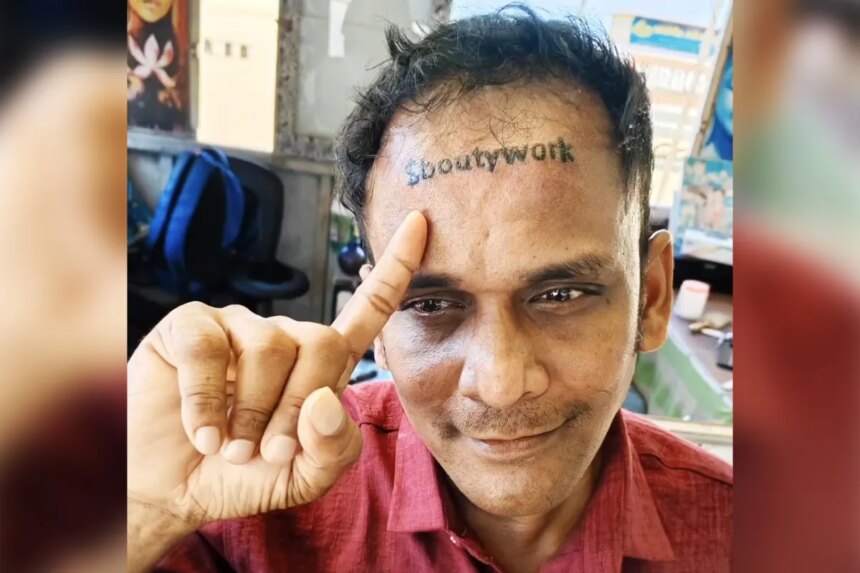
Humiliation seems to have become a central theme in the tasks being facilitated through Pump.fun. A glaring example is Arivu, a resident of Southern India, who accepted a bounty of 40 SOL—approximately $2,600—to tattoo the misspelled phrase “$boutywork” above his eyes. He documented this painful experience in a video shared earlier this month.
Despite the glaring error in spelling, the incident sparked momentum for a new meme coin titled “$boutywork,” which quickly gained traction and reached a market cap of $373,000 within hours. Such scenarios are not unfamiliar in the crypto world, where dubious meme coins often attract fleeting attention before plummeting in valuation, leaving unsuspecting investors at a loss.
Interestingly, Arivu managed to benefit from this faux pas, rumored to have earned just shy of $29,000 in transaction fees, a gesture from the creators of the token likely intended as a reward for his unusual commitment. However, the tattoo’s permanent location on his forehead begs the question of whether the financial gain is worth the price of public humiliation.
Pump.fun’s approach effectively commodifies humiliation, reflecting trends in a society increasingly susceptible to crypto-related scams and willing to gamble on outcomes ranging from petty competitions to dire conflicts. This sobering development raises alarms even within the crypto community, highlighting concerns about the sustainability of a market already plagued by questionable practices.
A user expressed frustration regarding this new trend, questioning how to maintain credibility for the broader industry when platforms are incentivizing public embarrassment and risky behaviors. “Instead of ‘make a meme’ or ‘write a thread,’ people are now being rewarded for permanent body changes, public embarrassment, risky stunts, and real-life disruption,” the user tweeted.
Nikita Bier, the head of product at X, also expressed his dismay over the trend, lamenting that the once-vibrant crypto environment seems to have devolved into a space where the wealthy are absent, leaving behind a landscape dominated by younger individuals reportedly coercing financially vulnerable people into shameful acts.
As the situation evolves, the implications of such developments in crypto culture remain under scrutiny, raising questions about the moral and ethical compass driving these new online trends.