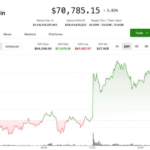
The cryptocurrency market is witnessing further declines as major financial markets undergo a significant sell-off, influenced by ongoing geopolitical tensions and investors aiming to reduce their risk exposure. Bitcoin, often seen as a bellwether for the crypto sector, fell below $90,000, reaching its lowest point in over a week. Currently, the total market capitalization for cryptocurrencies has dropped to approximately $3.01 trillion, reflecting a 4.27% decline in just the past 24 hours. Key cryptocurrencies like Bitcoin and Solana have breached critical support levels, with clear downward momentum evident in their trading patterns.
Data from CoinDesk reveals that as of the latest reports, Bitcoin is trading at $89,450, having experienced more than a 4% decrease over the last day and around a 14% decline year-over-year. Notably, Bitcoin has seen a consecutive six-day losing streak, accumulating short-term losses nearing 8%. This ongoing selling pressure fronts characteristics suggestive of market consolidation amid rising uncertainty and diminished risk appetite.
Smaller-cap tokens have not been spared, with Ethereum plunging more than 7% below the $3,000 level, while Solana reported a 5.3% drop. In line with these declines, crypto-related stocks have also weakened; Coinbase Global’s shares fell by 5.6%, and Strategy Inc., known for its Bitcoin holdings, suffered an almost 8% drop.
In contrast to the broader market trend, Strategy announced a substantial acquisition of Bitcoin, spending nearly $2.13 billion over a mere eight days—its largest purchase since July of the previous year. Jake Ostrovskis, head of over-the-counter trading at Wintermute, indicated that this significant investment reflects ongoing robust demand from both retail and institutional investors for exposure to Bitcoin, especially through equity vehicles like stocks. This led to Bitcoin briefly outperforming Ethereum on the day of the announcement.
Despite the sizable buy-in from MicroStrategy, Bitcoin’s falling prices underscore escalating market volatility. Even with an influx of around $1.2 billion into various Bitcoin ETFs in the U.S. this year—money that had previously buoyed Bitcoin prices after last year’s downturn—current market conditions demonstrate that investor sentiment has soured. MicroStrategy’s acquisition has resulted in unrealized losses of approximately $17.4 billion on digital assets since the last fiscal quarter, further complicating market confidence.
Analyzing the current situation, Bloomberg News noted that volatility, combined with corporate disclosures detailing unrealized losses, has dampened the optimistic outlook that many held towards cryptocurrencies. Reuters adds that the falling prices of both MicroStrategy’s stock and Bitcoin suggests a market perception that this large purchase may represent a ‘temporary peak.’
Recent geopolitical developments, notably related to former President Trump’s controversial Greenland acquisition proposal and subsequent trade conflicts, have added layers of complexity to market reactions. According to CNBC, these issues have led to increased risk aversion among investors and market participants. European leaders have condemned the Greenland proposal, firmly supporting both Greenland and Denmark amidst escalating diplomatic tensions with the U.S.
Fleeing from risk assets, many funds have sought refuge in more stable investments, further diminishing immediate demand for Bitcoin. The market capitalization for Bitcoin has shrunk from nearly $2 trillion earlier this month to about $1.78 trillion, indicating significant capital withdrawal and prompting the recent severe price drops.
The Open Interest metric, which measures the total amount of long and short positions, recently rebounded to around $29.8 billion as Bitcoin plunged below the $90,000 mark. Rising Open Interest along with falling prices indicates a surge in short positions, reflecting declining confidence among institutional investors.
Market sentiment is now dominated by a ‘risk-off’ approach, leading to decreased demand for Bitcoin as selling pressure is expected to influence coming trading sessions. Shiliang Tang, Managing Partner at Monarq Asset Management, attributed Bitcoin’s sharp decline to broader trends in risk assets influenced by macroeconomic factors, including potential tariffs on European nations and geopolitical friction.
Technical analysis highlights Bitcoin’s challenge in reclaiming solid support levels. Falling below the key psychological level of $90,000 has undermined recent bullish signals and shifted trend constructs, with the market now testing support levels around $80,600.
In terms of critical price points, the upcoming resistance levels are marked at $91,500 and $98,000, while support levels could be seen around $86,000 and the Fibonacci retracement level of approximately $80,500. The Average Directional Index (ADX) reading currently stands at 30.5, indicating a declining momentum trend, while the Relative Strength Index (RSI) at 41.7 suggests Bitcoin remains in a slightly bearish zone without entering oversold conditions yet.
As traders navigate this turbulent landscape, caution is necessary, with many analyzing potential inflection points that could dictate Bitcoin’s short-term trajectory amid ongoing volatile market conditions.