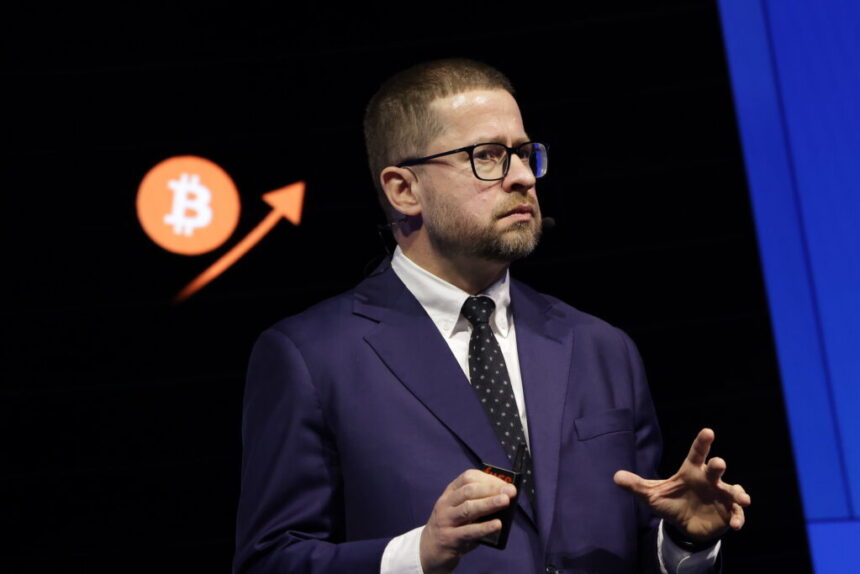
During a recent event in Las Vegas, Czech National Bank Governor Aleš Michl addressed attendees about the institution’s evolving approach to reserve management, particularly its decision to incorporate Bitcoin into its investment strategy. Michl highlighted the dual goals of strict inflation control and a calibrated exposure to digital assets as essential components of their financial approach.
Upon taking office in mid-2022, Michl faced a daunting inflation rate of nearly 20% in the Czech Republic. He described the central bank’s commitment to reducing inflation to a target of 2% within two years, emphasizing that this achievement was reached through disciplined measures rather than mere wishful thinking. He pointed out that prolonged periods of cheap money had weakened the national currency and flooded the economy with excess liquidity. The bank’s response was to bolster savings and enhance the strength of the Koruna, with the guiding principle now being a perpetual hawkish stance on monetary policy.
In detailing the size and scope of the Czech National Bank’s operations, Michl revealed that the institution oversees approximately $180 billion in foreign exchange reserves, representing about 44% of Czech GDP. He noted that these reserves are among the largest when compared to the country’s economic size, underlining the importance of sound financial management as they “build for the future.”
As part of a strategic shift, Michl discussed moving away from low-yield bonds and toward a more diversified portfolio that includes equities and precious metals. This diversification is said to protect the country’s financial health and enhance the potential for returns.
The discussion pivoted to Bitcoin, which Michl described as having a low long-term correlation with traditional reserve assets. Acknowledging its notorious price volatility, he argued that many assets experience fluctuations and that the crucial factor for a central bank is understanding how these assets interact within a larger portfolio. Research conducted by the Czech National Bank indicated that Bitcoin, over extended periods, can yield returns that remain largely independent of other assets.
Consequently, the central bank adopted a 1% allocation to Bitcoin within its reserves. Michl explained that this modest inclusion is expected to improve returns when measured in Czech Koruna while maintaining overall portfolio risk at a consistent level. “Adding Bitcoin to your portfolio enhances performance without increasing risk—it’s a matter of diversification,” he remarked.
Framing this foray into digital assets as part of a larger, forward-thinking philosophy, Michl advocated for a balance between conservatism and innovation in central banking practices. For the Czech National Bank, that translates to maintaining a resolute anti-inflation posture and safeguarding the domestic currency while cautiously experimenting with Bitcoin and other unconventional investment avenues to strengthen the country’s financial reserves over time.