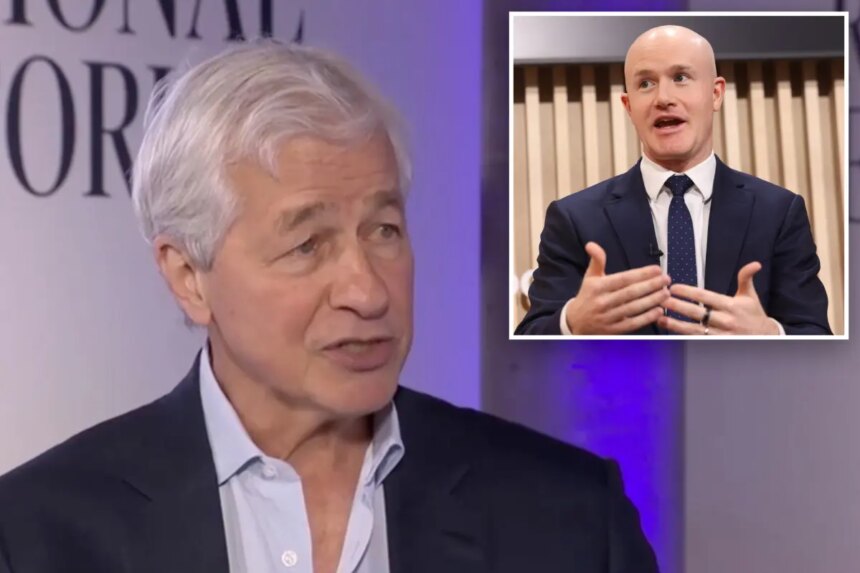
Jamie Dimon intensified his ongoing dispute with Brian Armstrong, the CEO of Coinbase, during a recent interview, where he expressed strong opposition to the current regulatory framework for the cryptocurrency industry. Dimon labeled Armstrong as “full of s–t,” reinforcing his staunch belief that major financial institutions will oppose the Clarity Act, a proposed legislative measure aimed at addressing regulatory gaps in the digital asset market.
In his remarks, the JPMorgan CEO emphasized that America’s largest banks are not prepared to accept the bill in its present form. He has consistently argued that companies like Coinbase should be subjected to the same regulatory scrutiny as traditional banks. Dimon highlighted JPMorgan’s substantial financial commitment to political activities, noting that the firm has allocated $75 million for the 2024 election cycle and maintains approximately $193 million in its super PAC, positioning it as a significant political player.
During the interview aired on Fox Business, Dimon expressed his disdain for Armstrong’s influence and financial efforts in Washington, claiming, “No one’s going to bow down to this guy, or that company.” He pointed out that Coinbase was investing heavily in lobbying efforts to sway lawmakers regarding the Clarity Act.
One of the primary points of contention between the two executives revolves around the ability of crypto exchanges, particularly Coinbase, to offer interest on stablecoins. Crypto advocates argue that such interest payments enhance product offerings, while traditional banking institutions view these practices as potential threats, warning they could result in simulated bank deposits devoid of adequate protections.
Coinbase reportedly offers attractive yields—approximately 3.5%—on dollar-pegged tokens like USDC, a stark contrast to the minimal interest rates provided by conventional banks on checking accounts. This disparity has raised alarms among financial institutions, which contend that these interest payments could lead consumers to withdraw their funds from banks, jeopardizing community lenders’ ability to finance local businesses.
The ongoing conflict has also seen Armstrong face criticism for retracting his support for earlier drafts of the Clarity Act in January, an action that has drawn significant attention in the regulatory debate. Senator Tim Scott, chair of the banking committee, noted that the legislation is intended to remain neutral between traditional finance mechanisms and emerging technologies, implying the complexity of balancing the interests of both sectors in the evolving financial landscape.