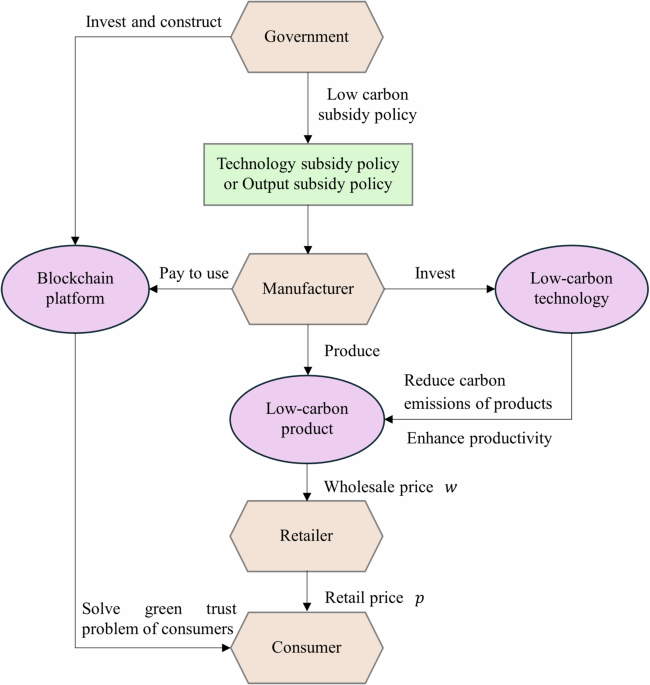
A recent study has highlighted the complex dynamics of government interventions aimed at promoting low-carbon technology (LCT) investments among manufacturers, particularly focusing on two strategic policies: the Technological Subsidy Policy (TSP) and the Output Subsidy Policy (OSP). These policies are evaluated based on whether manufacturers employ Blockchain Technology (BT) to improve transparency and consumer confidence in their carbon emission reduction claims.
Key findings suggest that the effectiveness of TSP and OSP varies significantly depending on the amount of subsidy provided to manufacturers and whether they choose to use BT. The study identifies a unique equilibrium solution that hinges on various coefficients impacting LCT investment, carbon emission reduction (CER) rates, market demand, pricing strategies, and the overall profitability of manufacturers and retailers.
Impact of Policy Coefficients
The research delves into the sensitivity of key equilibrium variables such as the LCT investment cost coefficient, consumer preferences for low-carbon (LC) products, and the degree of green trust.
-
LCT Investment Cost Coefficient: Higher costs associated with LCT investments inversely affect the equilibrium outcomes. As this cost increases, indexes such as the CER rate, demand, and profits for both manufacturers and retailers decline. This indicates a need for improved investment efficiency to enhance the attractiveness of low-carbon products in the market.
-
Consumer Preference Coefficient: An increase in consumer preference for LC products correlates positively with higher CER rates and demand. This heightened interest encourages manufacturers to invest more in LCT, suggesting that enhancing public awareness and appreciation of low-carbon products can drive substantial market changes.
-
Green Trust Factor: Greater consumer trust in LC product claims drives up demand and profitability, especially when BT is not applied. This implies that transparency and assurance in the product’s LC credentials can significantly stimulate market dynamics.
Comparative Analysis of TSP and OSP
The study presents a comparative analysis of TSP and OSP, revealing several critical insights:
-
Effectiveness Based on Subsidy Levels: Under low subsidy conditions, TSP tends to be more effective at increasing CER rates and profitability, while a larger subsidy shifts the advantage to OSP, emphasizing its ability to incentivize LCT investments more robustly.
-
Price Dynamics: TSP often results in higher wholesale and retail prices due to the direct linkage of the subsidy to CER rates. In contrast, OSP tends to promote lower prices to expand market scale, revealing how different policies serve distinct market objectives.
-
Demand Response: When subsidies are small, TSP attracts more demand compared to OSP, but as subsidies increase, the reverse is observed. This highlights the critical role of subsidy magnitude in influencing demand across different policies.
Influences of Blockchain Technology
The adoption of BT presents transformational implications for LC markets. When BT is applied:
-
Pricing Strategies: Manufacturers adjusting wholesale prices based on increased transparency may lead to higher retail prices, reflecting a complex relationship between trust, pricing, and company investment strategies.
-
Consumer Demand: The research indicates that the transparency offered by BT enhances consumer trust, which directly boosts demand for LC products. Consequently, firms are motivated to invest more aggressively in LCT to meet growing consumer expectations.
-
Profitability: The dual nature of subsidy structures further implicates profitability for manufacturers and retailers. Smaller subsidies tend to favor TSP, while increased subsidies make OSP more advantageous. This relationship emphasizes the importance of tailored policy designs that respond dynamically to market conditions.
Conclusion
In summary, the study underscores the delicate balance between pricing, transparency, and the effectiveness of government interventions in promoting low-carbon technologies among manufacturers. Both TSP and OSP present unique benefits and challenges, shaped by the application of blockchain technology and consumer preferences for low-carbon products. As policymakers refine their strategies, attention to the interrelated roles of subsidies, transparency, and consumer trust will be essential for fostering a more robust and sustainable low-carbon market.