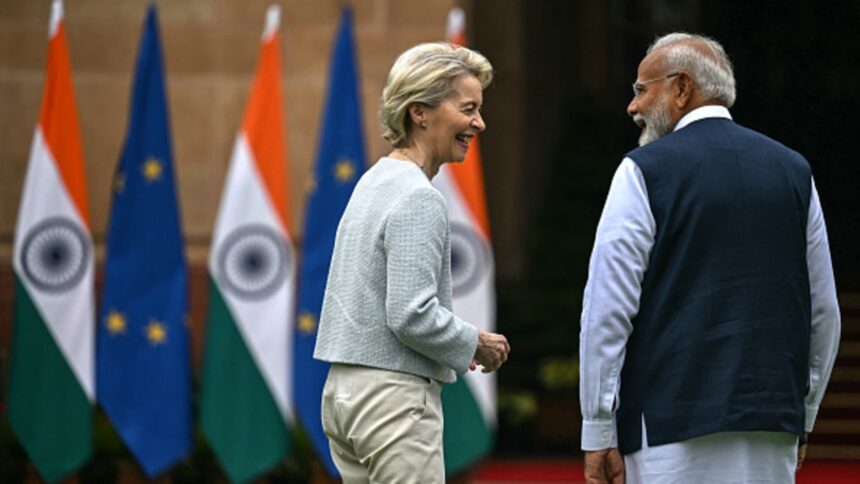
European Commission President Ursula von der Leyen met with India’s Prime Minister Narendra Modi in New Delhi, signaling a significant step towards a security and defense partnership between the European Union and India. This meeting, held at Hyderabad House on February 28, 2025, showcased the EU’s commitment to strengthening ties with India amidst rising geopolitical tensions.
Following the discussions, Modi announced a “landmark” free trade agreement between India and the EU, described as the “mother of all deals.” This agreement is significant as it encompasses around 25% of the world’s gross domestic product and a third of global trade volume, highlighting the pivotal role both regions play in the global economy. Key exports from the EU to India include machinery, transport equipment, and chemicals, while imports from India predominantly consist of machinery, chemicals, and fuels.
On the trading front, European stocks responded positively to the news of the trade deal. The pan-European Stoxx 600 index increased by 0.3%, with most sectors and major markets experiencing gains. However, the chemicals sector saw a slight downturn, with the Stoxx Chemicals index falling by 0.8%. Similarly, the automotive sector experienced a minor decrease of 0.7%.
As corporate earnings season kicks off, investors are keenly observing financial reports from major companies such as ASML, Volvo, LVMH, and Deutsche Bank. On this particular day, notable companies like Atlas Copco, Sandvik, and Logitech International were also expected to release their earnings.
Among individual stock performances, Puma experienced a notable surge of 8.6% following confirmation that China’s Anta Sports would acquire a 29% stake from France’s billionaire Pinault family for approximately 1.5 billion euros ($1.78 billion). Conversely, Swedish medical equipment manufacturer Getinge faced a decline of 6.5% after reporting a slight decrease in order intake for the fourth quarter of 2025, with total annual revenue underperforming expectations at 34.97 billion Swedish kronor ($39.1 billion).
British bootmaker Dr. Martens saw its shares tumble by 12% after reporting disappointing quarterly results, forecasting flat revenue growth for 2026. Revenue in the fiscal third quarter fell by 3.1% to £251 million ($343 million), primarily due to a significant decline of 7% in direct-to-consumer sales, despite an uplift in wholesale revenue.
In global trade developments, uncertainty arose following comments from U.S. President Donald Trump, who indicated plans to raise tariffs on imports from South Korea, citing the country’s legislature’s failure to approve a trade deal. This announcement led to fluctuations in South Korean automotive stocks, although losses were later mitigated.
As investors anticipate the U.S. Federal Reserve’s upcoming rate decision, expectations remain that the central bank will maintain its key interest rate within a target range of 3.5% to 3.75%. Traders are keenly awaiting insights regarding potential future rate cuts during this earnings-driven market environment.