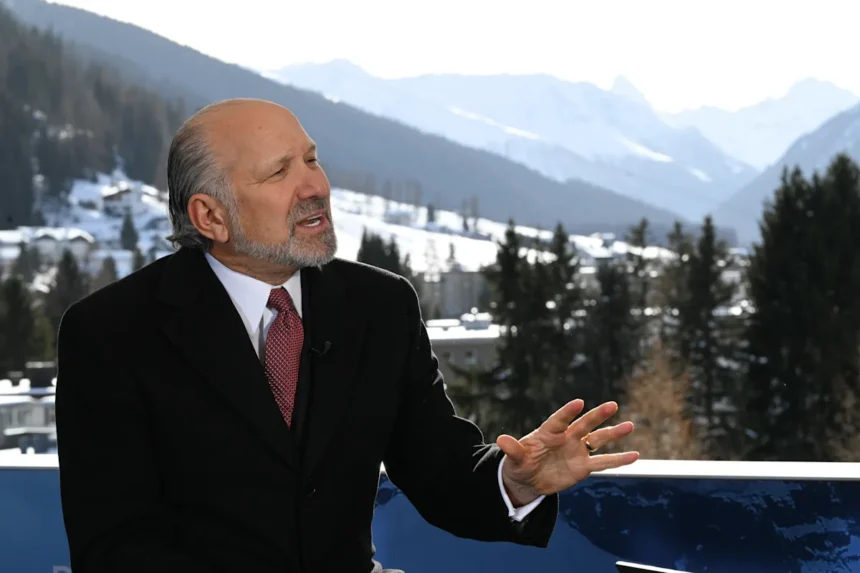
During a high-profile gathering in Davos, US Commerce Secretary Howard Lutnick emphasized a significant shift in the prevailing economic narrative, asserting that the Trump administration views globalization as “a failed policy” that has marginalized the US. The remarks came amid President Donald Trump’s predictions that the US stock market would double from existing highs, a sentiment he has repeatedly endorsed.
This juxtaposition reveals underlying tensions about the future of US investments, particularly from foreign entities. In recent years, foreign investors have shown a robust appetite for US equities, significantly contributing to the peak levels of stock indices that Trump has proudly highlighted. Notably, European investors have been particularly active in this market, raising concerns among Wall Street analysts that Trump’s combative rhetoric towards Europe could hinder this trend, potentially driving these key stakeholders away.
Vincent Mortier, chief investment officer at Amundi SA, Europe’s largest asset manager, noted a marked increase in client interest in diversifying investments away from the US, a trend beginning as early as April 2025, but gaining momentum more recently. With European investors holding about $10.4 trillion in US stocks—almost half of all foreign-held US equities—this shift could have significant implications for US markets.
Mortier cautioned that any move towards disentanglement will be lengthy and complex, as investors grapple with adjusting their portfolios while managing exposures to the US dollar. Recent developments have reflected this growing unease, with Trump’s tariff threats contributing to a notable drop in the S&P 500.
Analysts point out that Europe’s investment in US stocks, while substantial, is not indicative of a cohesive strategy to abandon US assets. However, individual asset managers from cities like London, Berlin, and Madrid are encountering increasing client inquiries regarding reducing exposure to US equities.
Historically, US equities have outperformed developed-market counterparts, but recent shifts in economic trends—characterized by a weakened dollar and increased fiscal spending by European governments—are prompting a reevaluation of investment strategies. In contrast to the US benchmark’s 16% gain last year, European markets such as the Stoxx 600 recorded a 32% increase in dollar terms.
Market strategists have noted that selling US assets would represent a significant shift for European investors, who have seen their investments in the region rise significantly in recent years. For instance, one pension fund in Greenland is currently debating potential divestment from US equities.
Trump’s administration has warned that wholesale divestments would invite “big retaliation,” a threat that has escalated concerns among European investors. As discussions of diversification intensify, there is a consensus that institutional investors are increasingly weighing the opportunities presented by European markets over US assets.
Despite the current limited impact on American equities, this emerging trend poses additional risks to a market operating at elevated valuations. Many analysts recommend caution against heavy exposure to US assets, especially amidst potential changes in foreign investment strategies.
Recent history has shown that financial markets can react to geopolitical tensions. Canadian investors voiced calls last year for their pension funds to reduce exposures to US stocks in response to perceived economic aggression from the Trump administration. Similarly, leaders like Prime Minister Mark Carney have suggested that nations dependent on US financial systems need to rethink their strategies, as trust in the US dollar faces unprecedented challenges.
As discussions of financial prudence and diversification become increasingly prevalent, some analysts assert that the current trajectory may prompt a longer-term adjustment in how investors view US markets. The uncertainty surrounding US policy directions evokes questions about the reliability of dollar-denominated investments moving forward, spurring a cautious approach among international investors aiming to mitigate risk.