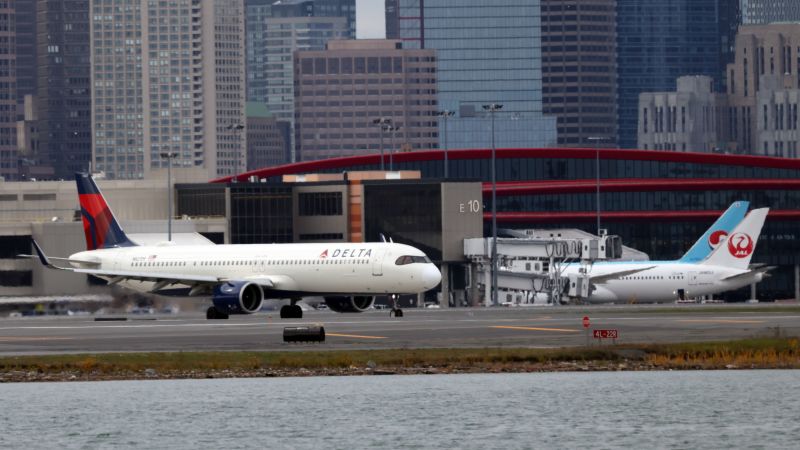
The Federal Aviation Administration (FAA) has launched an investigation into a potentially dangerous incident involving two commercial flights at Boston Logan International Airport that occurred on Saturday morning.
According to flight tracking data, Delta Air Lines Flight 2351 was forced to abort its landing approach around 11:30 a.m. due to a conflict with American Airlines Flight 3161, which was preparing for takeoff on a runway that intersected with Delta’s landing path. The pilots of Delta executed a go-around maneuver, safely climbing back into the air and later landing the Airbus A319 without further incident. Passengers disembarked normally, as confirmed by a spokesperson for Delta.
Analysis of the flight data indicated that the two aircraft came alarmingly close to each other, with the distance between them measuring just several hundred feet at the time of the incident. Audio captured from air traffic control communications revealed that an air traffic controller inquired about the destination of the American Airlines flight shortly before its takeoff. The pilot responded that the aircraft had received clearance from the control tower.
In light of recent aviation incidents across the United States—including a string of dramatic plane crashes and issues related to turbulence—this near-miss has raised further concerns about flight safety. Experts continue to emphasize that commercial aviation is an exceptionally safe mode of transportation, despite the recent uptick in high-profile incidents, which also includes other close calls and go-around scenarios.
The term “go-around” refers to the procedure where a pilot discontinues an attempted landing and climbs back up for further instructions. This safety maneuver is crucial for preventing runway incursions and mitigating hazards such as unexpected wind shifts or problematic approaches.
While go-arounds can surprise passengers, they are a common occurrence in the aviation world, with multiple instances happening daily across the United States. Michael McCormick, a former FAA air traffic manager and an associate professor in air traffic management, explained that while passengers may not be prepped for a go-around, they often recognize the maneuver when the aircraft suddenly ascends during an approach. He noted that pilots routinely practice go-arounds in flight simulators, underscoring their status as a standard safety procedure within aviation.